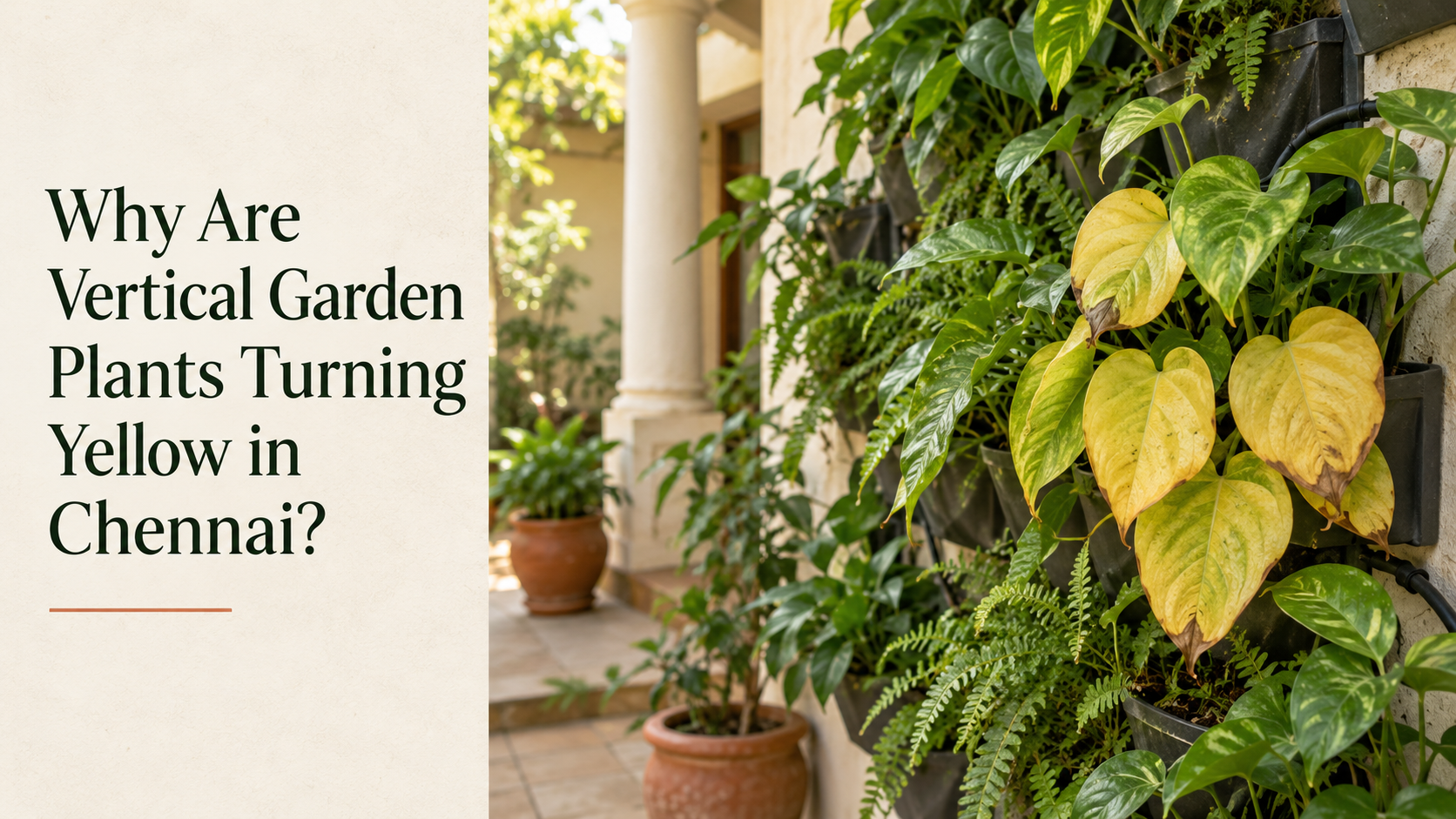
Why Are Vertical Garden Plants Turning Yellow in Chennai?
Are your vertical garden plants turning yellow, even though you water them regularly? Before adding fertiliser or increasing the watering time, take a closer look at the plants and their growing conditions.
Yellow leaves can develop because of excess moisture, dry roots, unsuitable light, nutrient problems or pests. Sometimes, a few older leaves are simply reaching the end of their life.
For a Chennai home, the position of the wall matters too. An exposed balcony, a sheltered courtyard and an indoor living wall need different care.
Start by checking moisture in several planting pockets, watching the irrigation system run and noting where the yellow leaves appear. These checks help you choose a useful next step without treating the wrong problem.
Vertical Garden Plants Turning Yellow: A Quick Symptom Guide
Leaf colour alone cannot confirm the cause. Use the following signs as clues, then inspect the plant and its growing medium.
| What you notice | Possible explanation | First check |
|---|---|---|
| Yellow leaves with persistently wet growing medium | Excess watering or poor drainage | Drain outlets and irrigation duration |
| Yellowing with dry, crispy edges | Dry roots, heat exposure or salt stress | Moisture inside the root ball |
| Several affected plants along one irrigation line | Uneven water delivery | Emitters, connections and supply |
| Pale or scorched leaves on the exposed side | Unsuitable direct sunlight | Actual sun exposure through the day |
| Yellow tissue between greener veins | Nutrient availability problem | Leaf age, root condition and growing-medium pH |
| Speckling, sticky patches or visible insects | Possible pest activity | Leaf undersides and stem joints |
| Only a few older leaves affected | Natural ageing may be involved | Whether new growth remains healthy |
These symptoms can overlap. A plant with damaged roots, for example, may wilt even while its growing medium is wet.
1. Too Much Water or Poor Drainage
Frequent watering is not always helpful.
If a planting pocket stays saturated, the roots have less access to oxygen. The plant may develop yellow leaves, weak growth or wilting. Adding more water because the leaves look tired can make the situation worse.
What to inspect
Check several pockets rather than touching only the surface of one.
Look for:
- Growing medium that remains very wet between watering cycles.
- Blocked drainage openings.
- Water collecting in trays or lower modules.
- A timer programme that continues unchanged after conditions become wetter.
Do not assume that all lower pockets are waterlogged. Different vertical garden systems move and drain water differently.
What to do
Restore drainage and adjust watering according to the plants and the moisture you find. Avoid letting the entire wall become completely dry as a reaction to a few wet pockets.
If a removable plant has soft, deteriorating roots or a rotting stem base, seek help identifying the problem before replanting it.
The University of Maryland Extension’s plant-problem guide identifies excess watering and poor root conditions among the possible causes of yellowing and decline.
2. Dry Pockets or Uneven Irrigation
A running timer does not prove that every plant receives water.
A loose connection, blocked emitter or poorly positioned outlet can leave one pocket dry while neighbouring plants remain healthy.
Check the complete watering cycle
Watch the system from start to finish.
Compare representative pockets at the top, middle, bottom and edges of the wall. Check whether water enters the growing medium around the roots or escapes along the side.
Where the design allows it, compare outlet delivery over the same period using suitable collection containers.
What to do
Repair disconnected tubing and clean or replace components according to the manufacturer’s instructions. Recheck delivery after the repair.
Avoid extending the watering time for the whole wall to compensate for one blocked outlet. That may leave other plants too wet.
Microirrigation delivers water close to the root zone, but good design and maintenance remain essential. The EPA’s microirrigation guidance explains how these systems work.
For related local planning information, read Win Landscape’s guide to drip irrigation in Chennai.
3. The Plants Receive Unsuitable Light
A plant chosen for its appearance may not suit the wall’s light conditions.
Some foliage plants struggle in strong direct sun. Others survive in a dim position but gradually lose vigour because the light is inadequate for healthy growth.
Check sunlight at different times
Observe the wall in the morning, around midday and later in the afternoon.
Ask:
- Which pockets receive direct sun?
- Has a shade cover or nearby plant recently been removed?
- Are larger plants shading smaller ones?
- Is the indoor wall relying only on decorative room lighting?
A wall that looks shaded during installation may receive direct sun at another time of day.
What to do
Match plants to the actual exposure. If plants need moving, make major light changes gradually where practical.
An indoor wall may need a properly planned grow-light arrangement. Ordinary decorative lighting should not automatically be treated as sufficient plant lighting.
The University of Georgia’s guide to growing indoor plants explains that both inadequate light and excessive exposure can affect plant health.
4. Nutrients Are Missing—or Roots Cannot Access Them
Yellow leaves sometimes indicate a nutrient problem, but adding fertiliser immediately is a poor diagnostic shortcut.
A plant may lack nutrients because the feeding programme is inadequate. It may also struggle to absorb nutrients because roots are unhealthy or the growing-medium pH is unsuitable.
Leaf patterns provide clues
General paling of older leaves can be consistent with nitrogen shortage. Yellow tissue between greener veins on younger leaves can suggest an iron-availability problem.
Neither pattern is a diagnosis on its own.
The RHS guide to nutrient deficiencies explains that growing conditions and pH can affect nutrient availability.
What to do
First check watering, drainage and roots. Then review:
- The fertiliser used.
- The measured dilution.
- How often it is applied.
- Whether the system uses potting medium or a hydroponic arrangement.
- Whether the affected plants have similar feeding requirements.
For repeated or widespread symptoms, testing the growing medium or nutrient solution is more useful than trying several supplements.
Avoid applying iron, magnesium or Epsom salts simply because a leaf is yellow.
5. Fertiliser Salts or Irrigation-Water Problems
More fertiliser does not always produce greener plants.
Excess dissolved salts can stress roots. Irrigation water may also contribute to salt accumulation, depending on its quality and how the system is managed.
Possible clues include crusty deposits, damaged leaf margins and problems that began after a change in fertiliser or water source. These signs are not specific enough to confirm salt damage.
What to do
Record recent changes to feeding and water supply. If the problem persists, arrange appropriate water and growing-medium testing.
Electrical conductivity, or EC, helps assess dissolved salts. pH measures acidity or alkalinity. They answer different questions, and neither provides a complete diagnosis alone.
Do not assume every Chennai borewell supply is unsuitable. Water quality varies by source.
Similarly, do not flush an installed living wall heavily without checking how runoff is collected and drained. In a recirculating system, flushing into the same reservoir may not remove the salts from the system.
6. Pests Are Feeding on the Plants
Inspect leaves closely before assuming that yellowing is a watering problem.
Look underneath leaves and around stem joints for insects, fine webbing, sticky residue or unusual speckling.
What to do
Photograph the signs clearly and identify the pest before choosing a treatment. If the system allows it, separate a badly affected removable plant while it is assessed.
Use any treatment only according to its label and suitability for the plant and setting. Avoid spraying the entire wall simply because a few leaves are yellow.
For example, North Carolina State Extension’s pothos profile advises monitoring this commonly grown foliage plant for mealybugs and scale. The same page also notes that overwatering can cause root problems, showing why inspection matters before treatment.
7. Natural Ageing, Recent Planting or Unsuitable Plant Selection
Not every yellow leaf signals a failing garden.
A few older leaves may yellow and fall while healthy new growth continues. Some varieties also naturally have yellow, cream or lime-coloured foliage.
Compare the plant with its normal appearance before deciding it is unhealthy.
Has anything recently changed?
Record whether the plant was recently installed, moved, repotted or exposed to different light.
A new installation deserves closer observation, but widespread decline should not be dismissed as “normal adjustment.”
Are different plants sharing one routine?
A vertical wall may contain plants with different moisture and light needs. One watering programme may suit some plants while stressing others.
If the same species repeatedly declines in the same position, reconsider whether it belongs there. Replacing it without correcting the conditions may repeat the problem.
Win Landscape’s vertical garden guide for Chennai provides related information for planning a living wall.
A Practical Inspection Routine for Chennai Homes
When vertical garden plants are turning yellow, a simple record helps separate an isolated plant problem from a system-wide issue.
Start with photographs
Take one photograph of the whole wall and close-ups of affected plants.
Note whether the yellowing follows a row, an irrigation line, an exposed edge or a particular species.
Check moisture before changing the timer
Compare affected and healthy pockets. Check within the growing medium where accessible rather than judging only its surface.
Watch irrigation and drainage
Look for missed pockets, leaks and water that fails to drain.
Record recent changes
Include changes to fertiliser, water source, shade, timer settings or plant placement.
Recheck after correcting the identified issue
Look for fewer newly affected leaves and healthier new growth. Avoid changing several unrelated things at once, because it becomes difficult to know what helped.
These steps apply to accessible modular or pocket systems. Hydroponic and recirculating installations also need checks appropriate to their pumps, reservoirs and nutrient-management design.
Should You Remove Yellow Leaves?
Remove fully dead leaves and fallen material carefully. Use clean tools and avoid damaging nearby stems.
Do not strip a plant of every slightly discoloured leaf before understanding the cause. Remaining healthy leaf tissue still supports the plant.
Removing yellow leaves improves appearance, but it does not repair blocked irrigation, poor drainage or unsuitable light.
Can Yellow Leaves Turn Green Again?
Some mild, reversible chlorosis may improve after the underlying problem is corrected. Ageing, badly damaged or dead leaves generally will not recover their original appearance.
Judge progress mainly by healthy new growth and whether the yellowing stops spreading.
There is no reliable recovery deadline for every vertical garden. Plant species, root condition and the severity of the problem all matter.
How to Prevent Repeat Problems
Build maintenance around observation rather than a fixed watering habit.
- Check several pockets instead of one convenient plant.
- Review irrigation when exposure or weather changes.
- Keep drainage routes clear.
- Record fertiliser applications and dilution.
- Inspect leaf undersides during routine care.
- Match replacement plants to the available light.
- Keep access available for maintenance.
For ongoing support, explore Win Landscape’s landscaping services and discuss a maintenance routine suited to your installation.
Need expert help? Win Landscape offers professional vertical garden installation in Chennai, along with complete landscaping services across the city. Book a free site visit to discuss your garden.
Frequently Asked Questions
Why are only the bottom plants turning yellow?
Possible explanations include moisture accumulation, restricted drainage or lower light. Check the actual pocket conditions before reducing watering across the entire wall.
Can overwatering and underwatering both cause yellow leaves?
Yes. Check the growing medium and roots to distinguish between them. Leaf colour alone is not enough.
Should I add fertiliser as soon as leaves turn yellow?
Check moisture, drainage, irrigation delivery and light first. Fertiliser will not repair a blocked emitter or damaged roots, and unnecessary feeding may add another problem.
How often should a vertical garden in Chennai be watered?
There is no single schedule for every wall. Plant selection, pocket size, growing medium, exposure and irrigation delivery all affect the requirement.
Is yellow colour normal on money plants?
It can be. Golden pothos naturally has yellow variegation, and some cultivars have lime-coloured leaves. A new change in colour, widespread leaf loss or declining growth needs closer inspection.
When should I get professional help?
Arrange an inspection when yellowing spreads rapidly, several plants collapse, roots appear to be deteriorating or problems keep returning after basic irrigation and drainage checks.
Get Help With Your Vertical Garden
Yellow leaves are a reason to investigate the growing conditions before replacing plants or adding more products.
Start with water delivery, drainage and light, then examine nutrients and pests where the evidence points.
To discuss your living wall and its maintenance needs, contact Win Landscape.