Front Yard Garden Ideas with Car Parking in Chennai
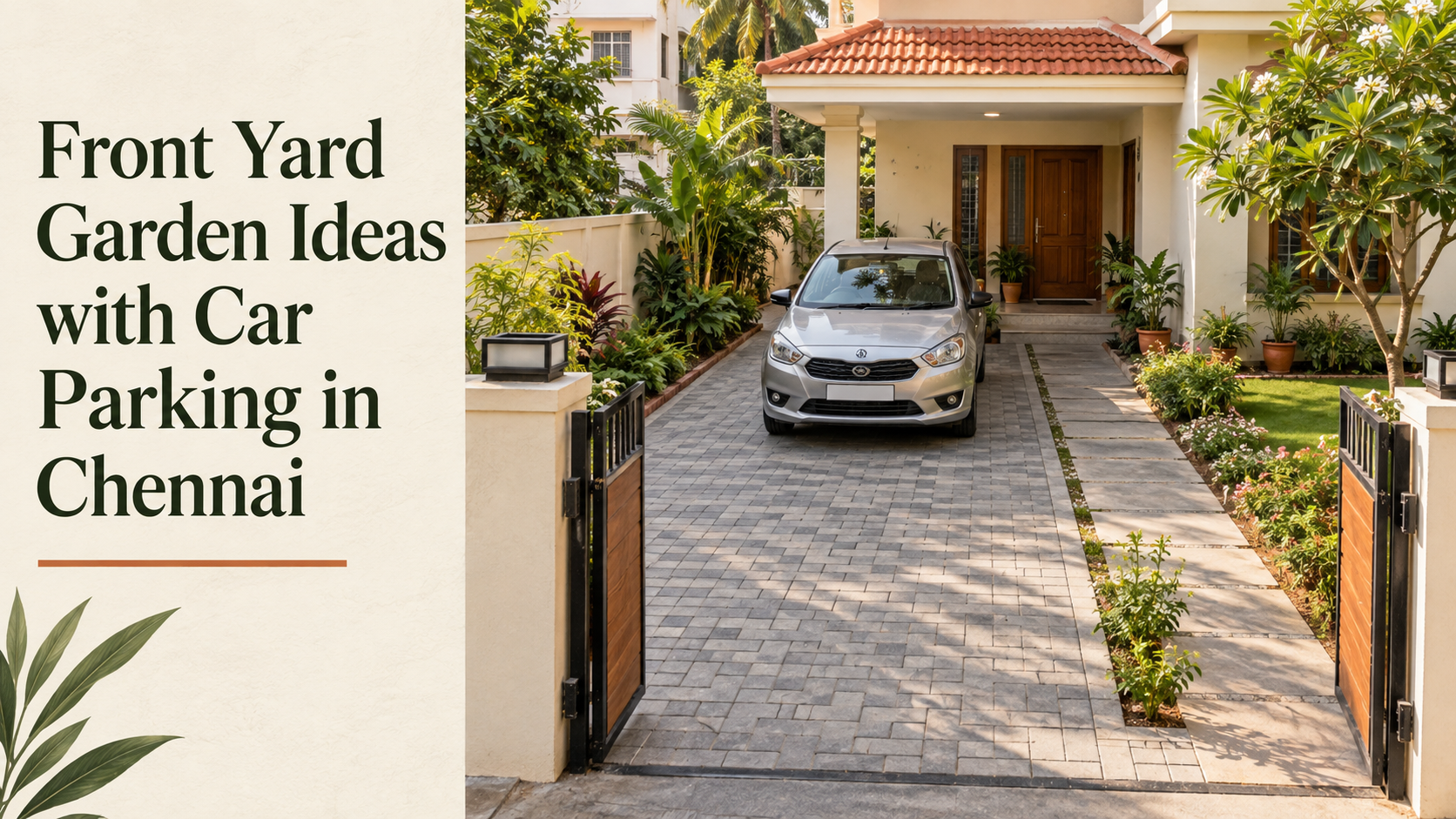
A parked car does not have to take away the greenery from your home entrance. With careful planning, even a compact front yard can accommodate parking, planting and a comfortable route to the door.
The most useful front yard garden ideas begin with everyday movement. You should be able to enter the gate, park, open the car doors and carry shopping indoors without moving pots or stepping through a flower bed.
For Chennai homes, sunlight, drainage and access for maintenance also deserve attention. An attractive entrance should remain practical after rain and when the car is parked.
Here are seven ideas to help you combine a garden and parking space.
Before You Design: Measure More Than the Car
The car’s length and width are only part of the space it uses.
You also need room for turning, mirrors, opening doors and accessing the boot. A layout that looks generous when empty may feel cramped once the vehicle is inside.
Try the layout with your actual vehicle
Park in the proposed position and check:
- Whether the gate can open and close.
- Whether passengers can get out comfortably.
- Whether the boot opens fully.
- Whether someone can walk to the entrance while the car is parked.
- Whether a scooter, cycle or delivery temporarily blocks access.
- Whether drain covers and utility points remain reachable.
Mark proposed bed edges with chalk or removable markers. Open the doors and walk around before committing to construction.
If you expect to change vehicles, include that possibility in the design brief.
These practical checks help establish the usable space; they do not replace any applicable building or access requirements.
1. Place a Planting Border Along One Side
A side border is one of the simplest ways to introduce greenery without breaking up the parking surface.
It works particularly well where one edge of the front yard can remain outside the vehicle’s movement and door-opening space.
Plan for mature plant size
Small nursery plants can look suitable for a narrow bed but grow into the parking area later.
Before selecting them, check:
- Mature height and spread.
- Light requirements.
- Pruning needs.
- Thorns or stiff projecting leaves.
- How easily the bed can be maintained.
Keep planting away from the passenger’s main exit point. Avoid placing sharp or thorny plants where people squeeze between the car and the boundary.
Repeat a limited selection
A few compatible plants repeated along the edge can give a small entrance a consistent appearance.
If you prefer locally appropriate planting, explore Win Landscape’s guide to native plants for Chennai gardens. Confirm the suitability of each species for the available root space and exposure.
2. Create a Clear Walking Route to the Entrance
A separate pedestrian route can make a shared garden and parking area much easier to use.
The route does not have to dominate the design. A change in paving pattern or a planted edge can distinguish it from the vehicle area.
Test it with the car parked
Check whether family members can reach the door without:
- Brushing against the vehicle.
- Walking through planting.
- Stepping over a drain channel.
- Squeezing past a large container.
- Passing behind a vehicle that is manoeuvring.
Where space is limited, prioritise a continuous, firm and even route.
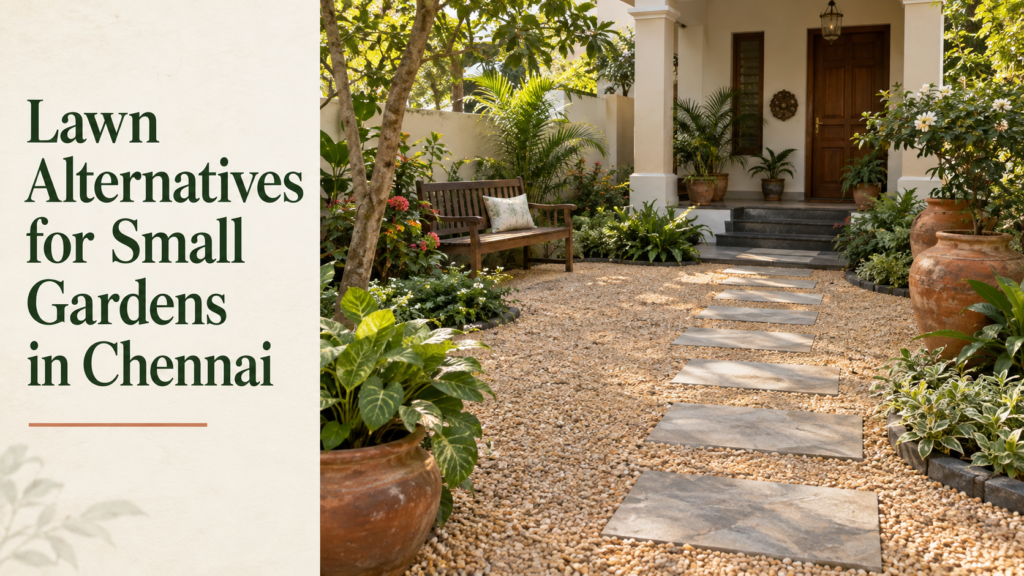
Stepping stones with wide gaps may look attractive, but they are less practical for carrying bags or using a walking aid.
Keep the entrance visible
Avoid placing tall planting directly where it hides the house entrance or makes it difficult to see someone approaching.
Low planting near movement areas can preserve greenery while keeping the layout easy to understand.
3. Combine Vehicle-Suitable Paving With Planted Edges
For a front yard used daily, a properly constructed parking surface can provide a dependable base for the design.
Choose a paving system suitable for the intended vehicle loading. The surface material is only one component; the base, edges and installation also matter.
Compare the complete system
| Surface option | Potential use | Important checks |
|---|---|---|
| Concrete paving blocks | Regular parking and access | Vehicle suitability, base construction and edge restraint |
| Natural stone paving | A coordinated entrance finish | Stone type, thickness, bedding and wet-weather grip |
| Permeable paving system | Parking where site conditions support it | Sub-base, infiltration, drainage and maintenance |
| Reinforced grass or gravel grid | Selected parking arrangements | Load rating, turning movements and upkeep |
| Loose decorative gravel | Planted margins and selected areas | Migration, walking stability and maintenance |
A material that works well for a garden path may not be appropriate beneath a car.
Understand permeable paving
A permeable system allows water through its surface into designed underlying layers. Its performance depends on the whole construction and the site beneath it.
The EPA’s explanation of permeable pavement describes how these surfaces can reduce runoff by allowing water into underlying layers.
Leaving gaps between ordinary paving slabs does not automatically create a reliable permeable parking system.
Ask the installer how excess water will be handled when infiltration is insufficient.
4. Use Wheel Tracks With Planting Where Conditions Allow
Two paved wheel tracks with a planted strip between them can create a greener appearance than a fully paved bay.
However, this arrangement suits some sites better than others.
Check vehicle movement first
Wheel tracks need to accommodate the vehicle’s approach and actual wheel path. A straight entry is different from a tight turn through a narrow gate.
Do not select track spacing from a reference photograph.
Check whether:
- The tyres remain on the supporting surface.
- Turning movements damage the planted strip.
- People have a firm place to step out.
- The car’s underside clears the planting.
- The layout accommodates other vehicles that may use the space.
Be realistic about plant performance
A car parked over the same strip for long periods changes the light and growing conditions beneath it.
Groundcover may become patchy where it receives limited light or repeated wear. Choose this option only when the planting conditions and maintenance commitment make sense.
For some homes, a full parking surface with a planted side border will be easier to manage.
5. Add Greenery to a Boundary Wall
Where ground space is scarce, a suitable boundary wall can provide another planting opportunity.
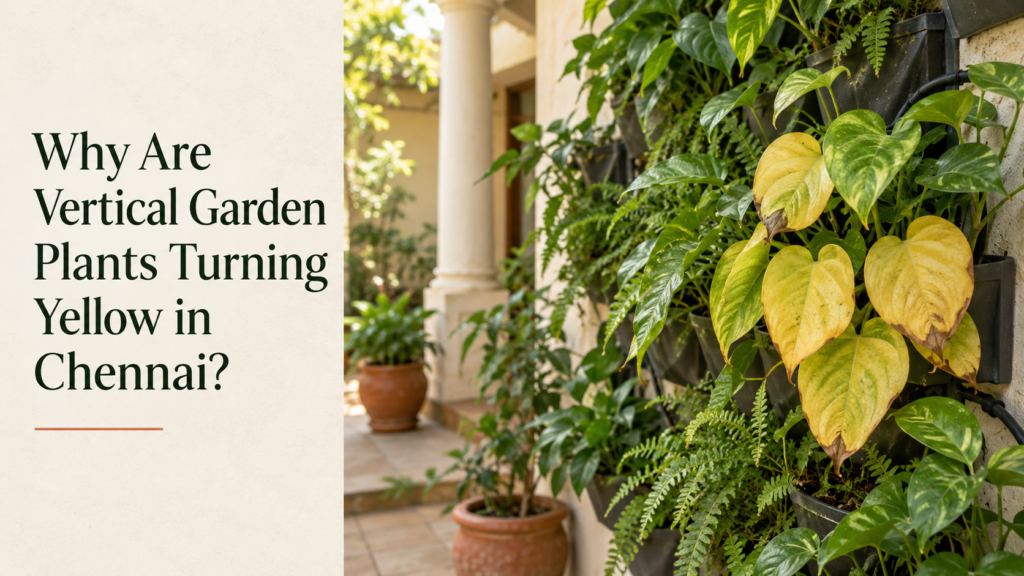
Options include a climber on a designed support or a modular vertical garden.
Keep maintenance access in the design
Before installation, consider:
- Access for pruning and replacing plants.
- Irrigation supply and drainage.
- The wall’s condition.
- The weight and fixing arrangement.
- Clearance from gates and moving vehicles.
Do not allow foliage to cover gate hardware, lights, meters or inspection points.
Keep water away from the parking route
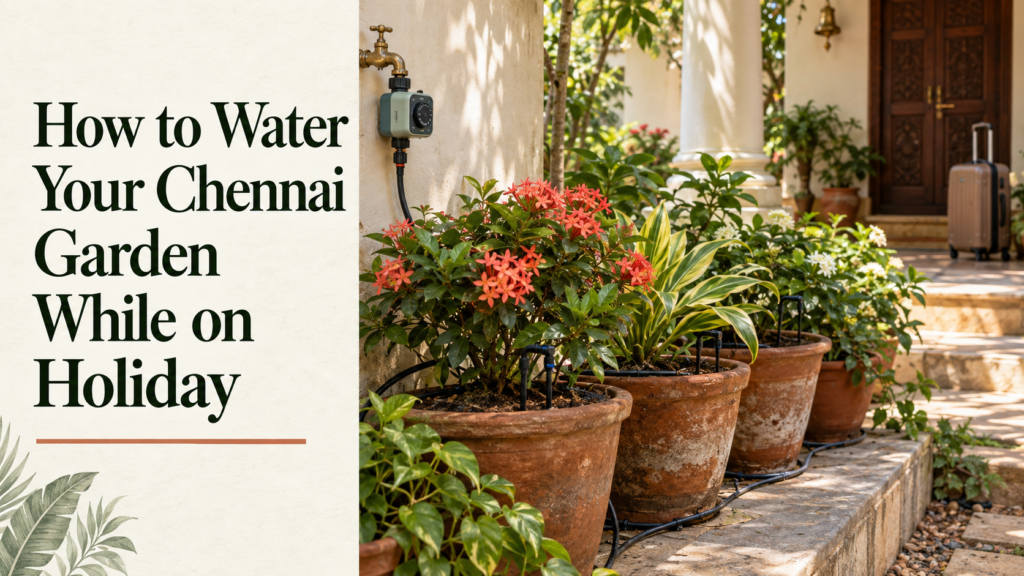
Plan where irrigation runoff will go. Repeated dripping onto the main walking surface can make cleaning more difficult.
A vertical garden also needs plant selection suited to its light conditions. A shaded wall beside a covered carport differs from an exposed boundary wall.
Read Win Landscape’s guide to vertical gardens in Chennai for related planning ideas.
6. Use a Few Well-Positioned Planters
Containers can add greenery to an existing parking area without immediately rebuilding the entire front yard.
They are useful for trying a layout before investing in permanent beds.
Choose positions that remain practical
Place containers where they do not obstruct:
- Car doors and mirrors.
- Gate movement.
- Drain covers.
- The pedestrian route.
- Access for cleaning.
Avoid relying on pots that must be moved every time the car enters. That routine often becomes inconvenient.
Check stability and drainage
Use stable containers and allow water to drain without repeatedly pooling in the access route.
Select plants according to the light at that particular position. Matching pots do not mean the plants inside them need identical watering.
For maintenance planning, see Win Landscape’s low-maintenance garden guide for Chennai.
7. Add Shade and Lighting Without Crowding the Yard
Shade can make a front yard more comfortable, while well-placed lighting helps people use the entrance after dark.
Both should be planned around the car and pedestrian route.
Consider the effect of a canopy
A carport or shade structure changes the sunlight reaching nearby plants. Choose planting after understanding that change.
Keep supporting columns outside door-opening and turning areas. Have the structure, fixings and roof drainage designed for the site.
An open pergola may provide partial shade, but it should not be assumed to provide rain protection.
Plan trees for their mature size
Where space permits, a suitable tree can contribute shade. Before planting, assess its mature canopy, root space and relationship to walls, paving and services.
Avoid choosing a large tree simply because the young plant fits the available corner.
Light the route clearly
Place lighting to help people identify the gate, path and changes in level.
Avoid glare towards drivers or neighbouring homes. Keep cables protected and have outdoor electrical work installed appropriately.
Front Yard Garden Ideas for Different Layouts
| Front-yard condition | Practical starting approach |
|---|---|
| Narrow frontage | One planted edge with an unobstructed parking and walking route |
| Wider single-car area | A defined parking bay, pedestrian route and corner planting |
| Covered parking | Plants selected for reduced light, with accessible containers or beds |
| Open sunny frontage | Planting matched to exposure, with shade considered where space allows |
| Two-car requirement | Confirm both parking movements before allocating planting space |
These are starting concepts, not measured designs. Gate position, columns, drainage and vehicle size can change what is feasible.
Plan Drainage Before Finishing the Surface
A new surface should not simply hide an existing water problem.
Before installation, identify:
- Where rainwater currently enters the yard.
- Where it collects.
- The levels near the gate and house entrance.
- Existing drainage outlets.
- Roof runoff from the porch or carport.
Keep drain covers accessible. Do not bury them beneath permanent planters or fixed decorative features.
The finished arrangement should avoid directing water towards the house or creating problems for neighbouring properties.
If the yard already becomes waterlogged, investigate the cause first. Win Landscape’s guide to garden drainage in Chennai provides related information.
Choose Plants for the Position, Not Just the Appearance
A parking garden needs a practical plant selection.
Consider mature spread, pruning access and whether leaves or branches will repeatedly contact the vehicle.
Near walking and door-opening areas, favour planting that remains manageable without constant cutting back.
Use taller planting only where it does not restrict visibility or access.
Where children or pets use the yard, include plant toxicity and physical hazards in the selection process.
The aim is to keep the planting healthy and well-proportioned as it grows—not only on installation day.
What Should Your Quotation Include?
Ask for an itemised quotation based on the same agreed layout.
Useful items include:
- Removal and disposal of existing surfaces.
- Ground preparation and base construction.
- Drainage work.
- Paving and edge restraint.
- Planting beds, containers and plants.
- Irrigation changes.
- Lighting or structural work where included.
- Establishment care and maintenance expectations.
A square-foot material price alone does not describe the complete job.
Also ask how repairs will be handled if access to an underground service is needed later.
Common Mistakes to Avoid
Designing around the car with its doors closed
Test passenger access and boot opening before fixing bed edges.
Filling every spare corner with pots
Allow space for people, cleaning and maintenance.
Choosing paving only by colour
Check vehicle suitability, grip, installation and drainage.
Expecting grass to thrive beneath a permanently parked car
Assess the actual light and wear before choosing a planted parking system.
Blocking visibility with dense planting
Keep sightlines clear where the vehicle approaches the gate.
Covering drainage access
Leave inspection points reachable after the garden is complete.
Need expert help? Win Landscape offers professional hardscape and hard landscaping contractors in Chennai, along with complete landscaping services across the city. Book a free site visit to discuss your garden.
Frequently Asked Questions
Can a small front yard have both a garden and car parking?
Yes, where the available dimensions support both uses. Start by confirming parking and walking space, then allocate the remaining area to suitable planting.
What is the simplest layout for a narrow front yard?
A clear parking area with one planted border is often a useful starting point. Check the actual car-door clearance before deciding on the bed width.
Are grass pavers suitable for daily parking?
They may be suitable when the product, base and planting conditions support the intended use. Frequent turning and prolonged shading from parked vehicles can affect the grass.
Which paving is best for a Chennai home entrance?
There is no single best material for every site. Compare vehicle suitability, wet-weather grip, drainage, maintenance and installation requirements.
Can I add a vertical garden beside the parking area?
Yes, if the wall, light, irrigation and maintenance access are suitable. Keep foliage and runoff away from moving vehicles and the main path.
How can I reduce maintenance?
Use a limited plant palette, avoid overcrowding, keep drain access clear and choose surfaces that are practical to clean.
Plan a Front Yard That Works Every Day
Good front yard garden ideas make the entrance attractive while preserving the space needed for parking and movement.
Start with measurements and a real parking test. Then plan drainage, surfaces and planting as one layout.
Explore Win Landscape’s landscaping services or contact Win Landscape to discuss a front yard garden with car parking for your Chennai home.