Lawn Alternatives for Small Gardens in Chennai
A small garden does not need a lawn to feel green and welcoming. If your grass struggles in shade, occupies space you rarely use or needs more maintenance than you can manage, another layout may suit your home better.
The best lawn alternatives for small gardens depend on how you use the space. A garden viewed from the living room needs a different surface from a busy entrance, a seating corner or an area where children play.
For Chennai homes, it is also useful to consider sunlight, watering access and what happens to rainwater before choosing plants or materials.
This guide compares seven alternatives and explains where each one can work.
Compare Lawn Alternatives for Small Gardens
Start with the activity you want the garden to support.
| Alternative | Suitable use | Maintenance to expect | Main limitation |
|---|---|---|---|
| Living groundcover | Decorative greenery and planted edges | Watering, weeding and trimming | Walking tolerance varies by plant |
| Stepping stones with planting | Occasional access through greenery | Joint care and plant maintenance | Gaps may be unsuitable for accessible routes |
| Gravel with planted islands | Decorative courtyards and informal areas | Raking, leaf removal and weeding | Loose surfaces can shift |
| Permeable paving with borders | Entrances, seating and regular access | Cleaning and joint maintenance | Needs a correctly designed base |
| Mulched planting beds | Replacing unused lawn patches | Pruning, weeding and mulch renewal | Does not provide an open play surface |
| A compact patio with planters | Sitting, dining and small courtyards | Surface cleaning and container care | Containers still need watering |
| A mixed garden with less lawn | Homes that still use some grass | Smaller lawn plus planted-area care | Requires a clear layout |
“Low maintenance” does not mean maintenance-free. The aim is to choose work you can manage and a garden you will use.
1. Living Groundcover for a Green Finish
Groundcover plants can replace grass in areas intended mainly for viewing rather than frequent walking.
They are useful beside a path, beneath suitable planting or in a small corner where a mower is awkward to use.
Choose plants for the actual location
Before buying a groundcover, check:
- Direct sunlight at different times of day.
- Whether the soil drains freely.
- Mature height and spreading habit.
- Watering needs during establishment.
- Tolerance of the intended foot traffic.
A plant that forms an attractive green carpet may still be unsuitable for repeated walking or play.
An option to assess: mondo grass
Mondo grass, Ophiopogon japonicus, is a grass-like groundcover that may be worth assessing for a shaded, well-drained garden.
North Carolina State Extension’s plant profile describes its preference for shade and moist, well-drained soil, and its use as a lawn alternative.
Confirm the exact variety before purchasing. Standard plants and dwarf selections do not produce the same height or appearance.
For a Chennai garden, trial a small area before committing to a complete replacement. Local exposure, drainage and plant quality still matter.
Where groundcover works best
Use it where greenery is the priority and provide a separate walking route for regular access.
Do not expect a newly planted patch to look fully covered immediately. Allow for establishment care and weed removal while plants spread.
2. Stepping Stones Surrounded by Planting
Stepping stones can preserve a planted appearance while giving you somewhere firm to place your feet.
This arrangement can suit a route to a garden tap, a small seating corner or an occasional maintenance path.
Plan the walking route first
Mark the route before selecting plants. Place the stones to suit a comfortable walking pattern rather than spacing them only for visual symmetry.
Choose a surface finish suitable for outdoor use and make sure each stone is stable.
Keep planting away from the main foothold so leaves do not hide edges or make the route difficult to follow.
When to choose a continuous path instead
A path used daily, or by someone using a wheelchair or walking aid, may need a continuous, firm and even surface.
Widely spaced stones and planted gaps can be inconvenient in these situations.
The garden can still remain green, with planting beside the path rather than between every step.
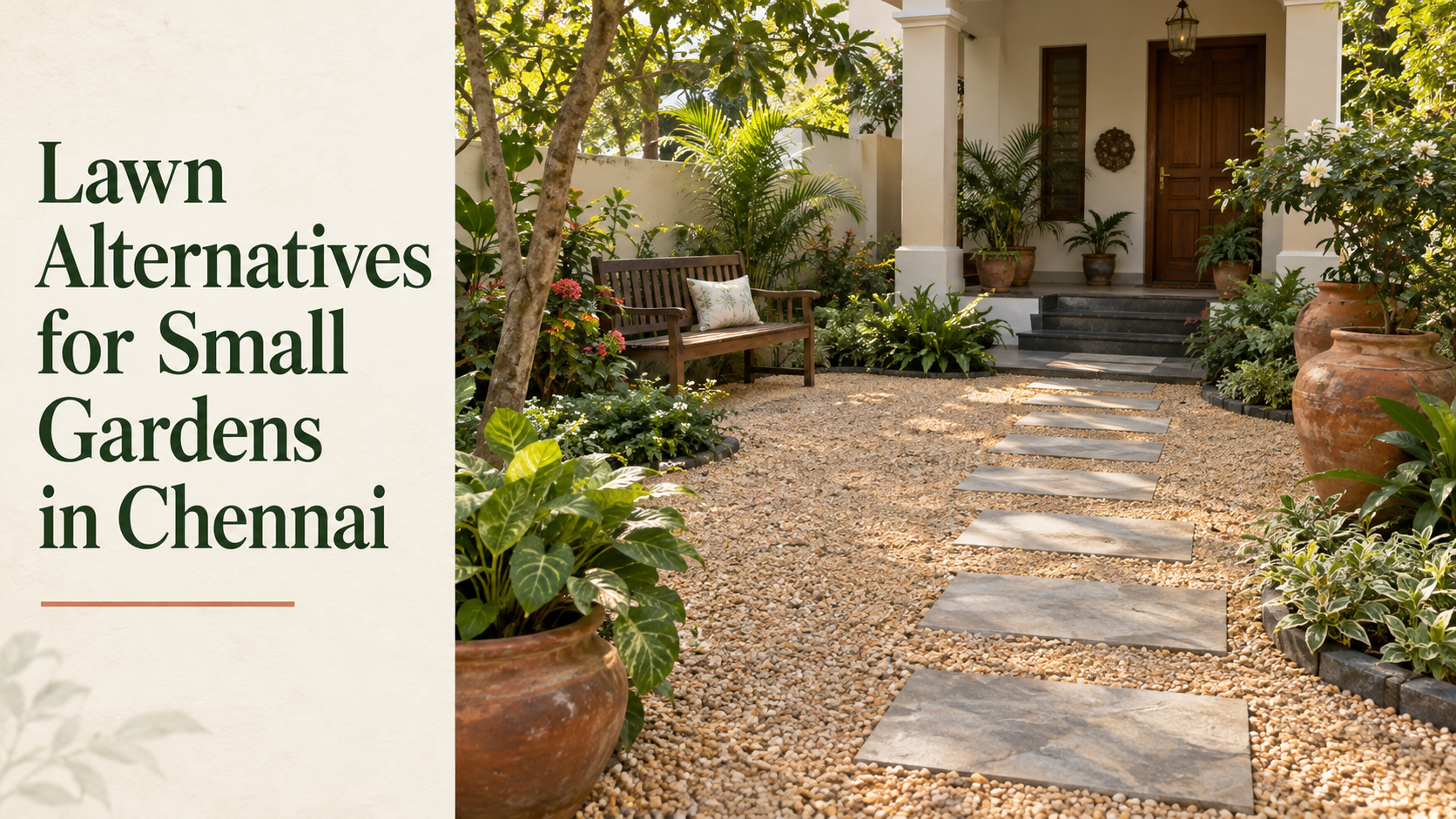
3. Gravel With Planted Islands
A gravel garden combines an aggregate surface with groups of plants.
It can suit a decorative front garden or courtyard where you want a simple finish without mowing.
Use a limited material palette. One aggregate colour, a few repeated plants and a clearly defined edge can make a small space easier to organise.
What to check before installation
Discuss:
- Aggregate size and shape.
- How the edges will contain it.
- Whether furniture will stand securely.
- How fallen leaves will be removed.
- Where rainwater will go.
Loose gravel can move underfoot. A firm path may be more practical along the main route.
Gravel does not automatically solve drainage
Water movement depends on the entire construction and the ground beneath it. Spreading gravel over a poorly draining surface does not guarantee that puddles will disappear.
If your existing lawn becomes waterlogged, investigate the cause before changing the surface. Win Landscape’s guide to garden drainage in Chennai covers this related planning issue.
Maintenance to expect
Gravel still needs occasional raking, weed removal and cleaning. Soil and decomposing leaves can collect between the stones over time.
It is a mowing-free option, not a care-free one.
4. Permeable Paving With Green Borders
If the garden serves as an entrance or seating area, paving may provide a more useful surface than grass.
Retain planting around it to soften the appearance and keep greenery close to the house.
Understand what “permeable” means
A permeable paving system allows water through the surface into designed underlying layers. Its performance depends on the paving, joints, base and site conditions working together.
The EPA’s explanation of permeable pavement describes this movement of water through the surface and underlying materials.
Ordinary paving does not become a complete permeable system simply because there are gaps between the units.
What to discuss with your installer
Ask about:
- The condition of the underlying ground.
- Finished levels near doors.
- The route for excess water.
- Surface grip when wet.
- Cleaning and joint maintenance.
- Access to existing drains and utilities.
Avoid choosing materials only from a photograph. View a sample outdoors and consider how the finish will feel and look in your garden.
5. Mulched Planting Beds
If nobody uses a patch of lawn, replacing it with a planted bed can give the space a clearer purpose.
A small bed might contain a few shrubs, flowering plants and lower plants arranged around one focal point.
Mulch covers exposed soil between plants. The RHS guide to mulching explains that suitable mulches can help retain moisture and suppress weeds. Organic mulches gradually decompose and need renewal.
Keep mulch away from plant stems and avoid burying low-growing plants.
Keep the design manageable
Choose plants according to their mature size. Crowding a small bed with too many shrubs can create repeated pruning work.
Leave access for watering, cleaning windows and maintaining nearby walls.
If you want locally appropriate planting ideas, explore Win Landscape’s guide to native plants for Chennai gardens. Confirm each plant’s size and site requirements before including it.
Who this option suits
Mulched beds work well for homeowners who enjoy plants but do not need a large open surface.
They are less suitable where the main requirement is running, ball games or frequent walking across the garden.
6. A Compact Patio With Planters
Sometimes the most useful change is creating somewhere to sit.
A small patio with a bench or a pair of chairs can make a garden part of daily life. Planters and a planted border can provide greenery around the seating area.
Design around real furniture
Mark the furniture footprint before deciding on the patio size.
Check that there is enough room to pull out a chair, open nearby doors and move through the space without stepping into planting.
Keep the main route clear rather than filling every available corner with pots.
Remember container care
Removing a lawn does not remove the need to water plants. Containers have limited growing space and need a suitable watering routine.
Choose pots with appropriate drainage and group plants with similar care needs.
For broader maintenance planning, read Win Landscape’s low-maintenance garden guide for Chennai.
7. Keep a Smaller Lawn and Change the Rest
A complete lawn replacement is not always necessary.
If your family enjoys sitting or playing on grass, retain a useful section and replace awkward strips with planting or paths.
This may work better than keeping grass beneath every shrub or along a narrow edge that is difficult to mow.
Give each area a purpose
For example:
- Retain an open grass area where it is actually used.
- Add a firm route between the gate and entrance.
- Convert an unused corner into a planted bed.
- Create a small sitting area where shade is available.
The proportions should follow your household’s needs. There is no fixed percentage of lawn that every small garden should retain.
This approach also lets you make changes in stages rather than rebuilding the entire garden at once.
What About Artificial Grass?
Artificial grass is another surface some homeowners consider, especially when they want a consistently green appearance without mowing.
Assess it as a manufactured surface with its own maintenance requirements.
Before choosing it, ask the supplier about:
- Surface temperature in direct sun.
- Drainage through the complete installation.
- Cleaning requirements, particularly with pets.
- Seam and edge repairs.
- Expected replacement and disposal arrangements.
Inspect an existing installation in conditions similar to your garden. Product appearance in a showroom may not tell you how comfortable or practical it will be outdoors.
How to Choose the Right Alternative for Your Chennai Garden
Before comparing quotations, write a short brief.
What do you do in the garden?
Decide whether the priority is viewing greenery, sitting, walking, gardening or play.
This decision helps narrow the options immediately.
Where does sunlight fall?
Observe the actual space at different times. A tall compound wall, neighbouring building or canopy can make one part of a small garden very different from another.
What happens after rain?
Note where water collects and whether it has a clear route away.
Changing the surface without addressing an existing drainage problem may leave the problem unresolved.
What maintenance can you manage?
Compare the work honestly.
Grass needs mowing. Groundcovers need establishment care. Gravel needs cleaning. Paving needs surface and joint maintenance. Containers need watering.
Choose the combination that fits your routine.
Plan the Budget Around the Complete Work
A price for plants or paving alone is not the full conversion cost.
Ask for an itemised quotation that identifies:
- Removal of existing turf and disposal.
- Ground preparation.
- Drainage improvements where needed.
- Base construction and edging.
- Plants and surface materials.
- Irrigation changes.
- Establishment care and maintenance expectations.
For a fair comparison, give each contractor the same area measurements and scope.
Avoid choosing solely by the lowest material rate. Preparation and installation affect how the garden performs after completion.
Common Mistakes to Avoid
Choosing a groundcover only because it looks like grass
Check walking tolerance, mature height and light requirements.
Covering the entire garden without planning drainage
Keep water movement part of the design from the beginning.
Using too many different materials
A small space can become visually crowded. Repeat a few compatible materials and plants.
Forgetting maintenance access
Leave room to reach taps, drains, windows and planting beds.
Assuming new plants need little water immediately
Establishment care remains important, even for plants chosen for lower ongoing water needs.
Need expert help? Win Landscape offers professional lawn installation and lawn grass supply in Chennai, along with complete landscaping services across the city. Book a free site visit to discuss your garden.
Frequently Asked Questions
What is the best lawn alternative for a small Chennai garden?
It depends on the use. Groundcover can suit decorative areas, while a firm paved route is more practical for frequent access. A combination often gives the most flexibility.
Can I walk on groundcover plants?
Some tolerate limited foot traffic, but tolerance varies. Provide a path where people walk regularly and confirm the exact plant’s suitability.
Is gravel cheaper than a lawn?
Not necessarily when the full installation is included. Removal, preparation, edging and drainage can change the cost. Compare complete quotations and ongoing maintenance.
Can lawn alternatives reduce watering?
Some layouts may reduce the area needing irrigation, but savings depend on the plants, previous lawn care and irrigation design. Newly planted areas still need establishment watering.
Is a lawn-free garden maintenance-free?
No. It changes the type of work rather than removing all maintenance.
Should I remove all my grass?
Only if grass no longer serves a useful purpose. Keeping a smaller lawn can be a practical compromise.
Plan a Small Garden That Fits Your Home
The right lawn alternatives for small gardens make the space easier to use and care for.
Start with the walking route, seating needs, sunlight and drainage. Then choose greenery and surfaces that support those requirements.
Explore Win Landscape’s landscaping services or contact Win Landscape to discuss a small garden layout for your Chennai home.