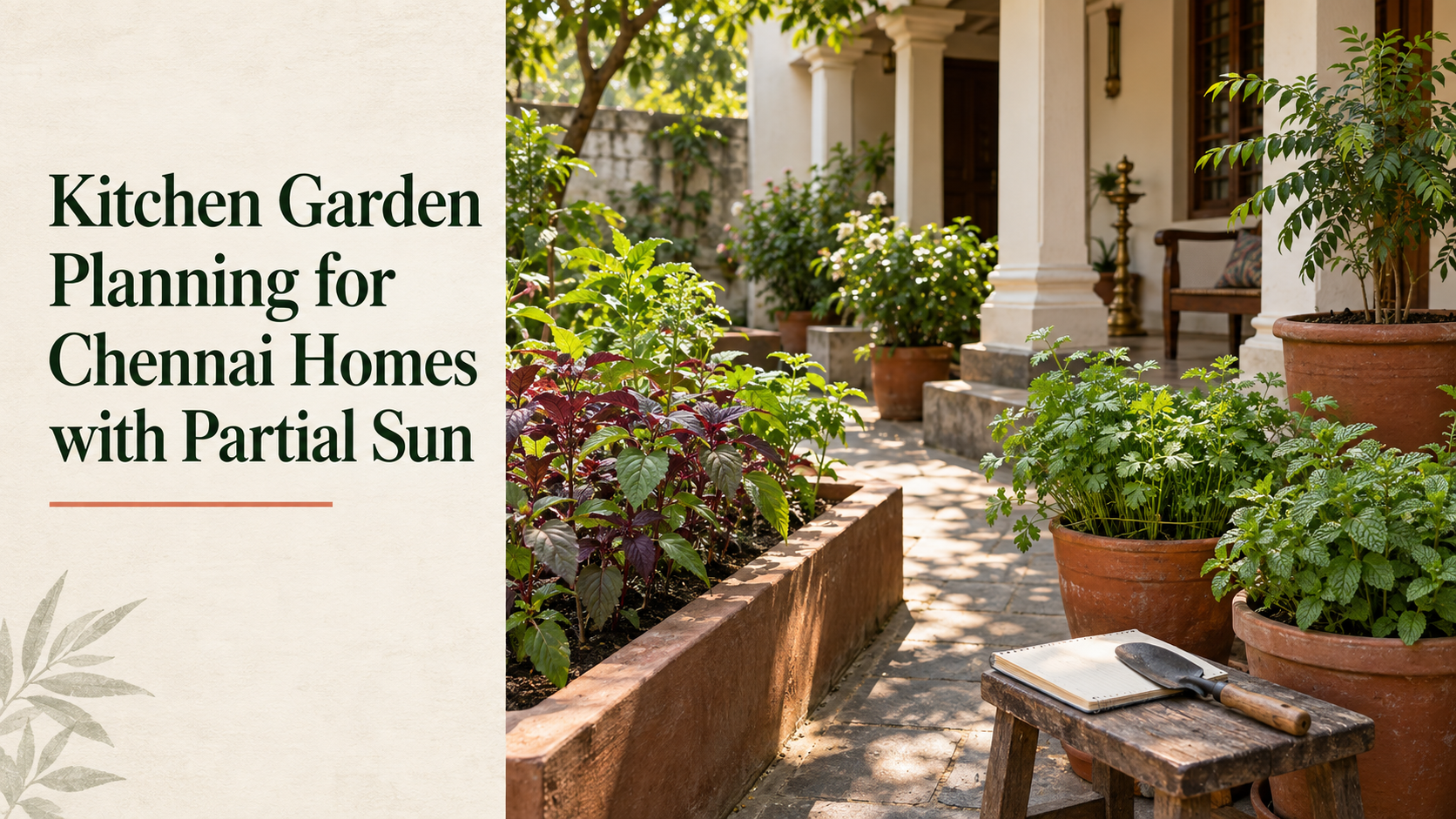
Kitchen Garden Planning for Chennai Homes with Partial Sun
You do not need a large, open terrace to start growing food at home. A balcony, side passage or courtyard can provide space for a small kitchen garden—even when sunlight reaches it for only part of the day.
Successful kitchen garden planning starts with understanding that light. The plants you choose should match the conditions you have, as well as the ingredients you enjoy using.
For a Chennai home with partial sun, a few well-placed containers of herbs and leafy crops can be a more realistic starting point than a crowded collection of tomatoes, chillies and gourds.
The aim is to create a manageable garden that provides useful harvests. Start small, observe the results and expand what grows well.
1. Start Kitchen Garden Planning With a Sunlight Check
A balcony can look bright without receiving much direct sunlight.
Direct sun reaches the leaves without a roof, wall or other obstruction blocking it. Bright indirect light illuminates the space, but it is not equivalent to the same number of hours in direct sun.
Record the light before buying plants
On a reasonably clear day, check your proposed growing area in the morning, around midday and during the afternoon.
Record:
- When direct sunlight first reaches each position.
- When it disappears.
- Which areas remain shaded.
- Whether reflected heat or drying wind affects the pots.
Repeat the observation on another day. Recheck as the season changes because the pattern of shadows can shift.
What can different light levels support?
As a broad starting point, some leafy vegetables can grow with around three to five hours of direct sun. Fruiting crops such as tomatoes, peppers and brinjal generally need more—often six to eight hours.
These are planning guidelines, not guaranteed production thresholds. Temperature, variety and growing conditions also matter. The University of Maryland Extension’s container vegetable guide explains this distinction.
For a deeply shaded space with little direct sun, keep expectations modest. More fertiliser cannot compensate for insufficient light.
2. Choose Crops for Both Light and Temperature
Partial shade tolerance does not automatically mean a crop will perform well during hot weather.
Some leafy vegetables accept reduced sunlight but still prefer cooler growing conditions. Consider both factors before choosing seeds.
A practical shortlist
| Crop | Where to consider it | What to watch |
|---|---|---|
| Mint / pudina | A bright position with partial sun | Spreading growth and drying roots |
| Coriander / kothamalli | A light, sheltered position during suitable cooler conditions | Early flowering in heat |
| Leaf lettuce | A small trial during milder conditions | Heat stress and bitterness |
| Suitable Asian leafy greens | The brighter part of a partially sunny space | Variety-specific heat tolerance |
| Tomatoes, chillies and brinjal | The sunniest available position | Reduced flowering and yield when light is limited |
Treat this as a starting shortlist rather than a promise that every crop will thrive on every balcony.
Mint: a useful first herb
Mint can be a practical choice if you use it regularly in cooking.
Spearmint tolerates partial shade and prefers moist, well-drained growing conditions. It spreads strongly, so give it a separate container instead of planting it among slower-growing herbs. North Carolina State Extension’s spearmint profile describes these characteristics.
Identify the edible mint variety when buying it. Plants sold under a broad common name may differ.
Coriander: plan for heat-related flowering
Coriander can grow in light shade, but hot conditions can cause it to bolt—produce a flower stalk earlier than you want for leaf harvesting.
For Chennai homes, try small batches when conditions are milder and compare results. Shade may reduce exposure, but it does not guarantee a long harvesting period.
The North Carolina State Extension coriander profile notes its preference for cooler conditions and tendency to bolt in heat.
Do not assume every “keerai” has the same needs
Keerai includes different leafy crops. Check the exact species and variety rather than treating the name as one plant category.
Similarly, true spinach, amaranth and Malabar spinach are different crops. Their temperature preferences, growth habits and support requirements are not interchangeable.
3. Arrange the Garden Around the Best Light
Once you know where the sunlight falls, give that space to the crops that need it most.
Avoid arranging containers only by colour or pot size. A neat-looking row may leave the most demanding plant behind a wall or beneath a shelf.
A simple starter layout
For a small balcony, begin with four to six containers:
- One separate mint pot.
- One container for a coriander trial.
- Two containers for suitable leafy crops.
- One additional container for a second sowing.
- An optional trial crop in the brightest position.
This is an illustrative layout, not a fixed planting prescription.
Keep the plants you harvest frequently within easy reach. Leave space to water, inspect leaves and remove a pot if it develops a problem.
Be careful with vertical racks
A rack creates more planting positions, but it does not create more sunlight.
Check whether upper containers shade the lower shelves. Position plants according to the light each shelf actually receives.
For more ideas on using compact outdoor spaces, explore Win Landscape’s guide to balcony gardens in Chennai.
4. Select Containers and Growing Medium Carefully
Choose containers for the mature crop, not just the size of the seedling.
A small nursery pot may be suitable temporarily but become difficult to water consistently as roots fill it.
Container checks
Before planting, confirm that:
- The container provides enough root space for the crop.
- Drainage holes are open.
- The pot stands securely.
- Runoff has a suitable route.
- You can reach the plant without leaning over a railing.
Use containers intended for growing plants, and avoid repurposing containers that previously held hazardous substances.
For balconies and terraces, consider the combined weight of wet growing medium, containers and water. Have substantial installations assessed where load capacity is uncertain.
Use a suitable potting mix
Container roots need access to both moisture and air.
Choose a growing mix intended for vegetables in containers. Avoid assuming that heavy soil taken from the ground will perform well in a pot.
There is no single homemade ratio suitable for every garden. Check how the mix behaves after watering: it should retain useful moisture while allowing excess water to drain.
Cocopeat alone is not a complete long-term feeding programme. Review the nutrients already included in the mix and the crop’s ongoing requirements.
5. Water According to Moisture, Not a Fixed Habit
Partial sun can reduce drying compared with an exposed position, but it does not remove the need to check plants.
Two pots beside each other can dry at different rates because of their size, crop, growing medium and exposure.
Build a simple watering routine
Check the growing medium before watering. Look beyond a dry-looking surface where possible and learn how the pot feels as it dries.
Water the root area gently, allowing the medium to absorb it. Check that excess water can drain.
Avoid repeatedly adding small amounts without checking whether the root zone is being moistened.
Watch sheltered pots during rain
Rain may reach an open terrace while missing containers beneath a balcony roof.
Check actual moisture instead of assuming all pots received water.
Would drip irrigation help?
A small drip system can make routine watering easier, but each outlet still needs to reach the intended container. Test delivery and adjust the schedule using observations.
Win Landscape’s guide to drip irrigation in Chennai provides related planning information.
6. Sow Small Batches and Keep Feeding Measured
A kitchen garden is easier to manage when everything does not reach harvest at the same time.
Instead of filling every container with one crop, use a second sowing after observing how the first batch develops.
Keep a short crop record
| Record | Why it helps |
|---|---|
| Crop and variety | Identifies what performed well |
| Sowing date | Helps compare growth between batches |
| Container position | Connects results with sunlight |
| Feeding details | Reduces accidental overfeeding |
| Harvest notes | Shows whether the crop is useful to your household |
Follow packet instructions for sowing depth and spacing. Thin overcrowded seedlings where required rather than allowing them to compete in a dense clump.
Fertiliser cannot replace light
If plants stretch towards the light or grow weakly, review their position before adding more feed.
Follow the fertiliser label and consider what is already present in the growing medium. Avoid combining several products without understanding their nutrient content.
A measured routine makes it easier to identify what helps and what may be causing problems.
7. Inspect Regularly and Harvest With Care
A quick, regular inspection is more useful than waiting until an entire container looks unhealthy.
Check leaf undersides, growing tips and the surface of the growing medium. Look for insects, chewing damage, unusual spots or changes in growth.
Identify problems before treating them
Yellowing leaves do not automatically mean a nutrient shortage. Moisture problems, poor light and pests can produce overlapping symptoms.
Photograph the problem and check the plant’s conditions before choosing a treatment.
For edible crops, use only products labelled for the intended crop and purpose, and follow any stated interval between treatment and harvest. Do not assume a homemade or “natural” spray is suitable simply because it is not synthetic.
Harvest according to the crop
Some greens allow repeated leaf picking; others are harvested as a whole plant. Follow the method appropriate to the variety.
Use clean tools and avoid removing so much foliage that a small plant struggles to recover. Wash harvested produce before use.
Set Realistic Expectations for a Partial-Sun Garden
A handful of mint for chutney or a small picking of greens can be a worthwhile result.
A few containers are unlikely to supply all the vegetables a household needs. Harvest size depends on the crop, usable sunlight, season, root space and care.
Instead of measuring success only by quantity, ask:
- Did the crop grow healthily?
- Did you use what you harvested?
- Was the watering routine manageable?
- Is the crop worth growing again?
This gives you a practical basis for expanding the garden.
Common Kitchen Garden Planning Mistakes
Choosing crops before checking sunlight
Start with the available conditions, then build the plant list.
Filling the space immediately
Leave room to learn, move containers and adjust the layout.
Adding shade cloth to an already shaded area
Additional shade may reduce useful light further. Use it only to address an observed need.
Keeping mint in a mixed herb container
Its spreading growth can make it difficult to manage alongside other plants.
Following an overseas planting calendar directly
Use general horticultural principles, but select sowing times and varieties for local conditions.
Expecting heavy harvests from weak light
Reduce expectations, choose a better position or reconsider the crop.
Need expert help? Win Landscape offers professional organic kitchen garden setup in Chennai, along with complete landscaping services across the city. Book a free site visit to discuss your garden.
Frequently Asked Questions
Can I grow vegetables with only three to four hours of sunlight?
Some leafy crops and herbs may provide useful growth, depending on the season and variety. Fruiting crops usually need more direct sun for reliable production.
Is morning sunlight enough for a kitchen garden?
It can support a small herb or leafy-crop garden if the duration and intensity are sufficient. Measure the actual exposure rather than relying on the balcony’s direction alone.
Can I grow tomatoes in partial sun?
You can trial them in the brightest position, but limited light may reduce flowering and yield. They are usually a less dependable first choice than suitable herbs or greens in a shaded garden.
Why does coriander flower so quickly?
Heat can encourage bolting. Try smaller sowings during suitable milder conditions and avoid expecting a single batch to supply leaves indefinitely.
Does partial shade mean plants need less water?
Sometimes, but container size, wind and plant growth also affect demand. Check moisture rather than applying one rule to every pot.
Should I use grow lights?
If natural light is inadequate, properly selected grow lights may help. Consider coverage, mounting, operating costs and suitability for the location before purchasing them.
Plan Your Chennai Kitchen Garden With Win Landscape
Good kitchen garden planning makes the best use of the space and sunlight already available.
Begin with a few suitable crops, keep watering and feeding manageable, and use your first harvests to guide the next planting.
Explore Win Landscape’s landscaping services or contact Win Landscape to discuss a kitchen garden layout for your Chennai home.