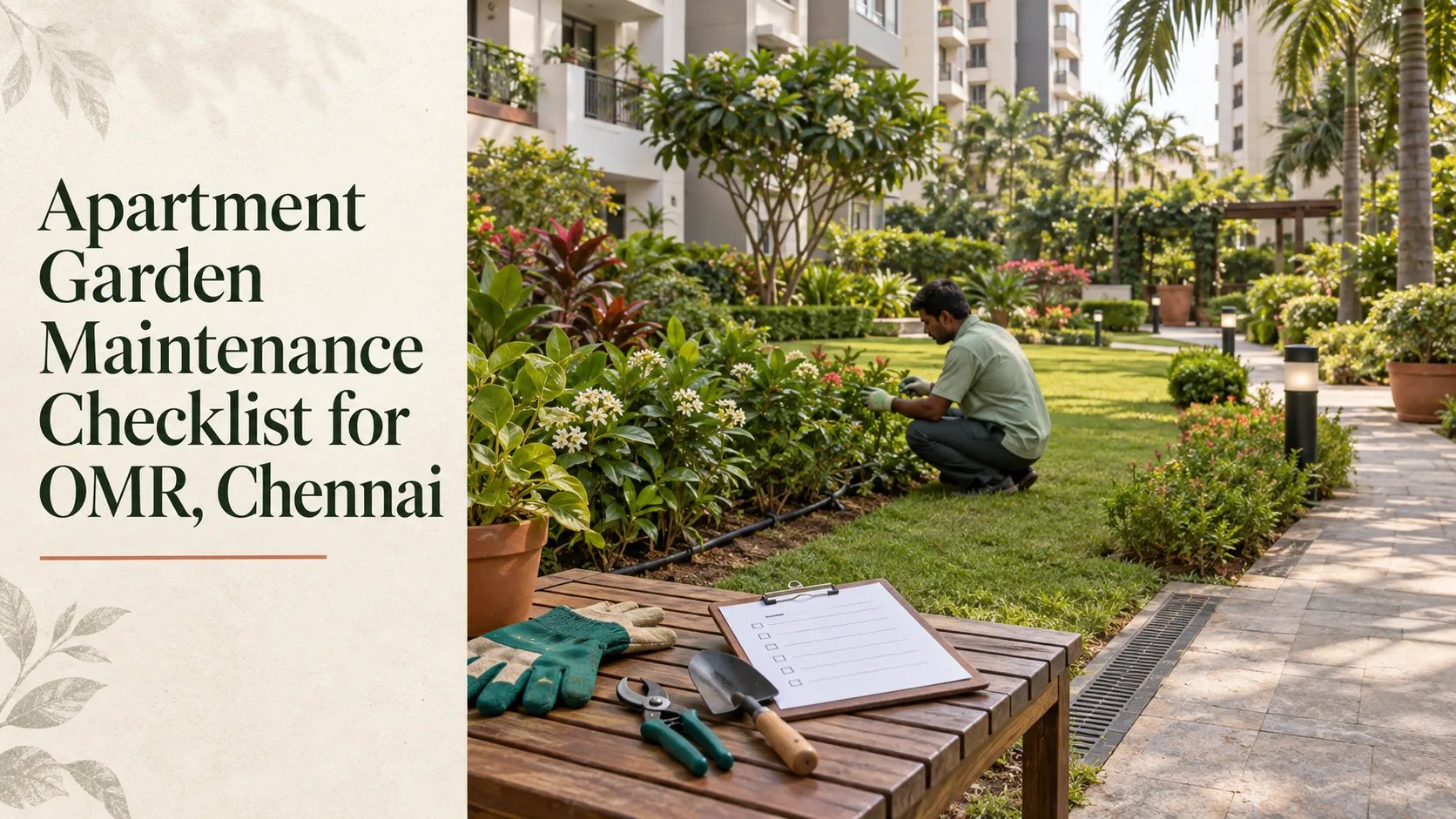
Apartment Garden Maintenance Checklist for OMR, Chennai
A shared garden needs more than regular watering and an occasional lawn cut. It also needs clear responsibilities, working irrigation, accessible drains and a simple way to report problems.
Good apartment garden maintenance helps residents enjoy the outdoor space while giving the association a clear understanding of what work has been completed.
For apartments along OMR in Chennai, start with the conditions inside the property. An exposed entrance bed, a shaded courtyard and planters above a basement slab can require different care.
This checklist provides a practical routine for facility managers, residents’ associations and gardening teams. Use the frequencies as starting points and adjust them to the plants, weather and condition of the site.
Start With a Garden Map and Named Responsibilities
Before creating a schedule, divide the landscape into manageable areas.
Useful labels might include:
- Entrance planting.
- Main lawn.
- Walking-path borders.
- Children’s play-area planting.
- Courtyard containers.
- Terrace or podium planters.
- Boundary trees and shrubs.
Give each area a reference name that the gardener and facility manager both understand.
Record the main plants, irrigation method, drainage points and any recurring problems. This makes a report such as “three blocked outlets in Entrance Bed A” much more useful than “watering problem near the gate.”
Assign responsibility for inspections, routine work and repairs. A gardening contractor may identify a pump fault, but an authorised technician may need to repair it.
Apartment Garden Maintenance Schedule at a Glance
The table below distinguishes inspection from treatment. Checking plants daily does not mean watering, spraying or feeding them daily.
| Frequency | Main tasks | Record to keep |
|---|---|---|
| Daily or each service visit | Check moisture, visible leaks, litter, fallen material and access routes | Short checklist and urgent issues |
| Weekly | Inspect plants closely, weed beds, review lawn condition and check irrigation coverage | Location-based notes and photographs |
| Monthly | Test irrigation zones, review plant losses, inspect mulch and assess service quality | Maintenance report and action list |
| Before forecast heavy rain | Check surface drains, loose items and known waterlogging areas | Preparation checklist |
| After heavy rain or strong winds, when safe | Check damage, ponding, displaced containers and blocked routes | Incident report and repair priorities |
| When symptoms or site conditions require | Soil or water testing, specialist tree assessment and targeted treatment | Findings and follow-up actions |
1. Check Watering and Irrigation Delivery
Watering should respond to plant needs rather than continue unchanged throughout the year.
Start each round by checking representative areas. Compare sunny beds, shaded beds, containers and newly planted sections.
The RHS guidance on watering explains that requirements vary with weather, soil, plant size and establishment. A single fixed routine cannot account for every area.
Daily watering checks
- Check moisture before adding water.
- Look for leaking pipes and overflowing containers.
- Confirm that vulnerable new plants are receiving attention.
- Check sheltered pots separately after rain.
- Keep hoses away from walking routes when not in use.
Do not assume wilting always means dry soil. Inspect the root-zone conditions before increasing irrigation.
Watch the system operate
At regular intervals, run each irrigation zone and inspect the actual delivery.
Look for blocked emitters, damaged sprinkler heads and water spraying onto paving instead of planting.
The EPA’s irrigation maintenance guidance recommends adjusting schedules to conditions, inspecting systems and correcting leaks or distribution problems.
For local planning context, read Win Landscape’s guide to drip irrigation in Chennai.
Track water use where practical
If a dedicated irrigation meter is available, record readings consistently.
An unexpected increase should trigger an inspection. Compare readings with rainfall, new planting and operating changes before drawing conclusions.
If the apartment uses treated wastewater for landscaping, have its suitability, handling and system operation assessed by the responsible specialists. Clear appearance alone does not establish water quality.
2. Maintain Lawns According to Growth and Use
A lawn should not be cut simply because a calendar says it is mowing day.
Review its growth, grass type and condition before scheduling the work. Set the mowing height appropriately for the turf rather than using one setting across every property.
Weekly lawn inspection
Check for:
- Bare areas along frequent walking routes.
- Persistent wet patches.
- Uneven growth.
- Weeds.
- Damage near play equipment or seating.
- Irrigation that misses part of the lawn.
Record the location and investigate the cause before replacing grass.
Address repeated wear
If residents repeatedly cross the same section, the layout may need a path rather than another patch of turf.
Similarly, grass that repeatedly struggles beneath dense shade may need a different planting approach.
Repeated replacement without correcting the conditions increases work without resolving the problem.
Coordinate mowing with residents
Schedule equipment use when the area can be managed safely. Keep people away from active work, remove debris and leave paths clean afterwards.
3. Inspect Plants Before Pruning, Feeding or Spraying
Routine inspection helps the team notice problems while they are still localised.
Check leaf undersides, new growth, stems and the growing medium. Compare affected plants with healthy plants nearby.
Record symptoms clearly
A useful note includes:
- Plant or bed location.
- Whether the issue affects one plant or several.
- Visible symptoms.
- Recent watering or treatment changes.
- A clear photograph.
- The proposed next step.
“Yellow leaves” alone is not enough information to justify fertiliser or pesticide application.
Prune for a clear reason
Pruning may be needed to remove damaged growth, maintain visibility or prevent plants obstructing paths.
Avoid cutting every shrub into the same shape regardless of its growth habit. Keep plant size manageable through appropriate selection and timely care.
Large branches, work at height and uncertain tree defects need suitably qualified personnel.
Use targeted treatments
Identify the likely cause before choosing a treatment. Follow the product label, including application instructions and restrictions on access.
Communicate treatment locations and relevant precautions to residents. Keep a record of the product, date and person responsible.
A calendar should schedule inspection—not automatic pesticide spraying.
4. Keep Beds Weed-Free and Review Soil Care
Weeds are easier to manage when noticed early.
Inspect bed edges, gaps around paving and spaces between young plants. Remove unwanted growth without damaging nearby roots or irrigation lines.
Check mulch condition
Suitable mulch can help conserve moisture and suppress weeds. Organic mulch gradually breaks down and needs renewal.
Keep it away from plant stems and avoid burying low-growing plants. These principles are explained in the RHS guide to mulching.
Check the existing layer before adding more. Repeated top-ups should not gradually bury the base of shrubs.
Feed according to need
Review the plant type, growing medium and previous applications before adding fertiliser.
Maintain a feeding record instead of relying on memory. If plants repeatedly perform poorly, investigate irrigation, drainage and soil conditions before increasing the dose.
Where testing is needed, use the results to guide the programme.
5. Keep Drainage and Shared Routes Clear
A tidy garden can still have serious maintenance problems if water has nowhere to go.
Inspect accessible surface drains, planter outlets and low points. Remove leaves and loose debris before they build up.
Routine drainage checks
- Keep inspection covers accessible.
- Check for soil washing from beds onto paths.
- Note puddles that repeatedly form in the same place.
- Check planter outlets for blockage.
- Report water appearing near building walls or below planted areas.
Do not cover a recurring drainage problem with decorative stones and assume it has been corrected.
Win Landscape’s guide to garden drainage in Chennai provides related planning information.
Pay attention to podium and terrace planting
Planters above occupied or service spaces need coordination between the gardening and building-maintenance teams.
Report suspected leakage promptly. Avoid digging, drilling or altering drainage details without understanding the underlying construction.
Keep routes usable
Remove hoses, tools and pruning waste after work. Report loose edging, damaged covers and slippery surfaces.
Do not allow planting to obstruct entrances, signs, service access or emergency routes.
6. Prepare for Weather Changes and Inspect Afterwards
Apartment garden maintenance should change when site conditions change.
For OMR properties, assess the actual exposure rather than assuming every apartment has the same soil, wind or water conditions.
During hotter, drier conditions
Review moisture in exposed containers and newly planted beds.
Check irrigation performance before increasing operating time. A blocked outlet will not be corrected by running the whole system longer.
Before forecast heavy rain
- Clear accessible surface drainage points.
- Secure or relocate loose lightweight items.
- Check known waterlogging areas.
- Review irrigation settings.
- Confirm who will inspect the grounds afterwards.
Avoid unnecessary watering when the root zone is already wet.
After rain or strong winds
When conditions are safe, check for fallen branches, unstable containers, washed-out soil and blocked routes.
Keep residents away from areas with suspected tree or electrical hazards until the appropriate team has assessed them.
Record repeated flooding locations so they can be investigated beyond the immediate clean-up.
7. Use a Monthly Report to Close Outstanding Work
A monthly report should show the condition of the garden and what needs attention.
It does not need to be long. Consistent records are more useful than a collection of unrelated photographs.
Include these items
| Report section | Information to include |
|---|---|
| Work completed | Areas maintained and dates |
| Plant condition | Losses, replacements and recurring symptoms |
| Irrigation | Leaks, blocked outlets and repairs |
| Drainage | Ponding locations and unresolved issues |
| Treatments | Products and fertilisers applied |
| Resident concerns | Issue, location and response |
| Outstanding actions | Named owner and target date |
| Photographs | Comparable views from fixed positions |
Avoid calling an issue “completed” when it has only been reported. Distinguish inspection, temporary correction and permanent repair.
Example issue entry
Location: Entrance Bed A
Observation: Two plants remained dry after an irrigation cycle.
Action: Blocked outlets cleaned and delivery rechecked.
Follow-up: Review soil moisture and plant condition at the next visit.
This is an illustrative entry, not a report from an actual Win Landscape project.
What Should an Apartment Maintenance Contract Cover?
Compare contractors using the same written scope.
Ask the quotation to identify:
- Areas included in the service.
- Visit frequency and staffing.
- Routine gardening tasks.
- Irrigation inspection responsibilities.
- Waste collection and disposal arrangements.
- Reporting and escalation procedures.
- Materials included or charged separately.
- Plant replacement terms.
- Specialist work excluded from the routine fee.
- Handover arrangements when staff change.
Define whether the contractor is responsible for irrigation repairs or only for identifying faults.
Also clarify whether tree work, pumps, electrical systems and waterproofing require separate specialists.
For related service information, explore Win Landscape’s guide to professional landscape maintenance in Chennai.
How to Review Maintenance Quality
Appearance is useful, but it is not the only measure.
Review whether:
- Reported leaks are being resolved.
- The same plants repeatedly fail.
- Watering reaches the intended areas.
- Drainage points remain accessible.
- Treatments are recorded.
- Resident complaints receive a clear response.
- Open actions are completed and checked.
Do not compare water use or plant losses without context. New planting, weather and changes in occupied areas can affect the figures.
Common Mistakes to Avoid
Watering every area identically
Group care according to plant type, exposure and root-zone conditions.
Replacing plants without diagnosing failure
Check the conditions before installing the same plant again.
Treating spraying as proof of maintenance
Inspection and targeted action are more meaningful than unnecessary applications.
Leaving responsibilities unclear
Name the person who reports, approves and completes each type of work.
Using photographs without follow-up
Link each problem photograph to a location and an action.
Focusing only on the entrance
Include less visible courtyards, boundary beds and service-side planting in the routine.
Need expert help? Win Landscape offers professional garden maintenance services in Chennai, along with complete landscaping services across the city. Book a free site visit to discuss your garden.
Frequently Asked Questions
How often should an apartment garden be maintained?
It depends on the size, planting and facilities. Frequent basic checks can be combined with scheduled detailed work. Inspection frequency should not be confused with a requirement to water or treat every plant.
Should apartment lawns be watered every day?
Not automatically. Check moisture, rainfall, turf condition and irrigation delivery before deciding on the schedule.
Who should monitor the gardening contractor?
A named facility manager or association representative should review the checklist, outstanding issues and monthly report.
What should be done about repeated plant deaths?
Review the affected location, plant selection, water delivery, drainage and growing medium before replacing plants.
Can one gardener handle the entire property?
Staffing depends on the maintained area, plant types, equipment, access and scope of work. Ask for a task-based assessment rather than relying only on apartment count.
What should residents report?
Residents can report leaks, fallen branches, blocked paths, persistent ponding and damaged planting. A location and photograph help the maintenance team respond.
Plan a Clear Maintenance Routine for Your OMR Apartment
A useful checklist connects regular inspections with timely action.
Start with a garden map, assign responsibilities and keep a short record of issues until they are resolved.
Explore Win Landscape’s landscaping services or contact Win Landscape to discuss the maintenance requirements of your apartment garden in OMR, Chennai.