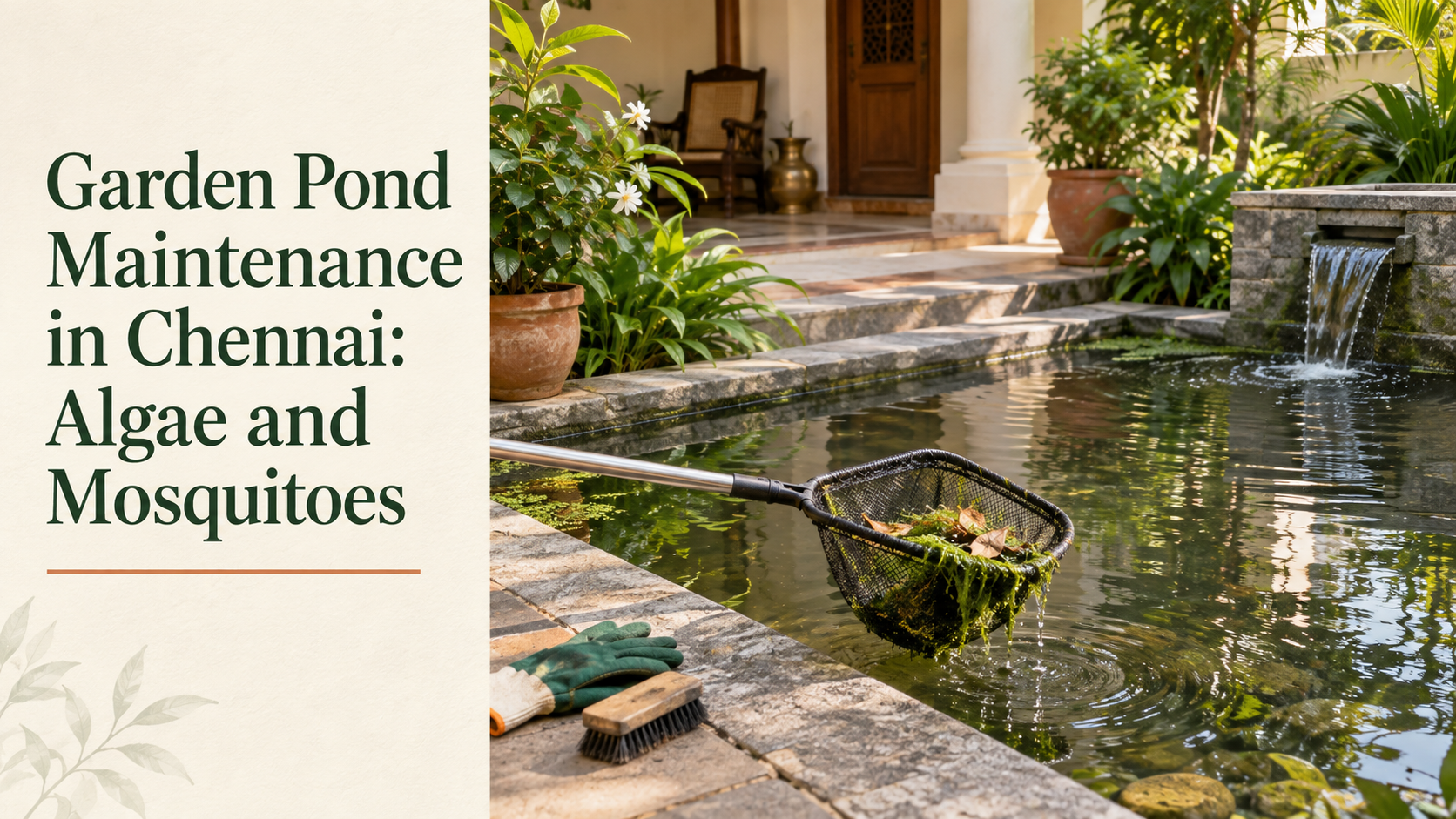
Garden Pond Maintenance in Chennai: Algae and Mosquitoes
A garden pond can make an outdoor space feel calm and inviting. But when the water turns green or mosquitoes appear nearby, it can be difficult to know what needs attention first.
Good garden pond maintenance starts by separating two different problems: algae growth and mosquito breeding. Green water does not prove that mosquitoes are breeding in the pond, and clear water does not prove that they are absent.
For Chennai homes, a practical routine should cover water movement, debris, filtration and small pockets of standing water around the garden.
Start with inspection rather than adding a treatment immediately. What works for an unstocked decorative fountain may be unsuitable for a pond containing fish and aquatic plants.
First, Identify What You Are Seeing
| Observation | Possible explanation | First action |
|---|---|---|
| Green water throughout the pond | Suspended algae may be present | Review feeding, debris, sunlight and filtration |
| Long green strands attached to surfaces | Filamentous algae | Remove accessible excess growth carefully |
| Small moving organisms near the surface | Mosquito larvae or other aquatic life | Confirm identification before treatment |
| Reduced waterfall or fountain flow | Blocked intake, low water or equipment fault | Inspect the system safely |
| Fish repeatedly gasping at the surface | Possible oxygen or water-quality problem | Seek prompt pond or aquatic-animal advice |
| Mosquitoes nearby but none found in the pond | Another breeding source may be present | Inspect containers, drains and plant saucers |
A photograph or short video can help a specialist identify an unfamiliar organism. Avoid assuming every small creature in the water is a mosquito larva.
1. Reduce the Material That Feeds Algae
Algae can use nutrients entering the pond through fish food, waste, decomposing leaves and runoff.
A small amount of growth on submerged surfaces is not the same as a sudden bloom covering the pond. The aim is to manage excessive growth while maintaining suitable conditions for the pond’s inhabitants.
Check what enters the water
Look for:
- Uneaten fish food.
- Fallen leaves and flowers.
- Dead aquatic foliage.
- Soil washing in from planting beds.
- Fertiliser runoff.
- Accumulated organic debris.
Remove loose surface debris before it sinks where practical.
If fish are present, review feeding and stocking with someone familiar with the species and pond system. Do not add more fish as a quick solution to a maintenance problem.
Keep surrounding beds separate from the pond
Avoid washing soil or garden treatments into the water during maintenance.
Where runoff repeatedly enters the pond, correct the surrounding drainage arrangement rather than relying only on pond cleaning.
Win Landscape’s guide to garden drainage in Chennai covers related outdoor drainage planning.
2. Check Circulation Throughout the Pond
A working fountain does not mean every part of the pond has useful water movement.
Quiet pockets may remain behind rocks, inside disconnected decorative bowls or among dense planting.
Inspect the complete system
Check:
- Pump operation.
- Water level.
- Intake blockage.
- Return-flow strength.
- Disconnected or leaking pipes.
- Areas where debris repeatedly collects.
Compare performance with the system’s normal operation. A reduced flow can be an early sign that cleaning or repair is needed.
Separate circulation from aeration
Circulation moves water around the system. Aeration promotes gas exchange. Depending on the design, one device may contribute to both, but they are not identical functions.
Choose equipment according to pond volume, depth, fish load and actual performance requirements.
Water movement can help make conditions less suitable for mosquito breeding, but it does not guarantee a mosquito-free pond. Continue inspecting sheltered areas.
3. Maintain Filters Without Disrupting the Whole System
Filtration should suit the pond rather than be selected only by pump size or appearance.
Mechanical filtration collects particles. Biological filtration supports microorganisms involved in processing waste. Some systems combine both.
Follow the equipment instructions
Check and clean mechanical components when their condition or reduced flow indicates a need.
For biological media, follow the manufacturer’s guidance. Avoid disinfecting or replacing all established media during routine cleaning, because this can disrupt the biological system.
Do not use household detergent to clean equipment that will return to a fish pond.
Understand the role of a UV clarifier
A correctly selected UV clarifier may help with suspended algae that causes green water. It does not physically remove attached algae, clear sludge or repair excessive nutrient inputs.
Check the specified flow rate, lamp maintenance and installation instructions. Treat it as one component of the maintenance system.
4. Manage Algae Gradually and Investigate Recurrence
Where practical, remove accessible excess filamentous algae manually without damaging plants, equipment or the liner.
Check removed material for trapped aquatic animals and dispose of it where it cannot wash back into the pond.
Review sunlight and planting
Assess whether the pond receives prolonged direct sunlight and whether suitable shading could form part of the design.
Avoid covering the entire surface with plants simply to hide the water. Preserve access, inspectability and suitable conditions for the pond’s inhabitants.
Be cautious with algae treatments
Do not select an algaecide solely because it promises fast results.
Product suitability depends on pond volume, water conditions and the fish, plants or other organisms present. Rapid decomposition of a large amount of killed algae can reduce dissolved oxygen.
For substantial blooms or a fish pond, obtain specialist advice before treatment. Follow the exact product label rather than using a generic internet dosage.
Repeated algae problems deserve a review of their cause, not repeated chemical treatment alone.
5. Inspect for Mosquito Breeding Inside and Around the Pond
Mosquito control needs a wider inspection than the pond itself.
A well-maintained pond may sit beside a forgotten bucket, blocked gutter or plant saucer that holds water.
The CDC’s mosquito-control guidance recommends checking water-holding items weekly and emptying, scrubbing, covering or removing them as appropriate.
Include these areas in your inspection
- Plant-pot saucers.
- Buckets and watering containers.
- Unused decorative bowls.
- Tarpaulin folds.
- Disconnected fountain sections.
- Accessible blocked drainage points.
- Uncovered water storage.
Do not apply “empty and scrub weekly” to an established fish pond. That advice is for removable water-holding items; a stocked pond needs a different maintenance approach.
If larvae are confirmed
Identify the breeding pocket and correct preventable causes, such as a disconnected section or failed pump.
For persistent breeding in water that cannot reasonably be emptied or covered, contact a qualified pest-control professional or the relevant local public-health team.
Adult mosquitoes around a garden do not establish that the pond is the only source.
6. Use Larval-Control Products Only When Appropriate
Bti—Bacillus thuringiensis israelensis—is used in some products to control mosquito larvae. It is not an algae treatment.
The EPA’s explanation of Bti describes its larval-control role and emphasises following product-specific instructions.
That US guidance does not establish whether a particular product is authorised or suitable for use in your Chennai pond.
Before using any larvicide, confirm:
- Its local authorisation and intended use.
- Suitability for an ornamental pond.
- Compatibility with the organisms present.
- The required dose and application interval.
- Any restrictions on access or water use.
Do not improvise with bleach, kerosene, diesel, detergent or household insect spray in the pond.
Do not introduce wild-caught or non-native fish simply as a mosquito treatment. Fish add care requirements and do not remove the need for inspection.
7. Keep a Simple Garden Pond Maintenance Record
A short record makes recurring problems easier to investigate.
You do not need complicated software. A notebook with dates, photographs and equipment observations is enough to begin.
Suggested maintenance checklist
| Frequency | What to inspect |
|---|---|
| Daily or during a routine garden walk | Water level, pump operation and fish behaviour where applicable |
| Weekly | Surface debris, sheltered water pockets and nearby water-holding containers |
| As equipment condition requires | Mechanical filters, intakes and pipework |
| Monthly review | Recurring algae, leaks, maintenance records and equipment performance |
| After heavy rain or power interruption | Runoff entry, overflow, pump restart and changes in fish behaviour |
| When symptoms occur | Appropriate water testing and specialist assessment |
These are inspection intervals, not instructions to dose chemicals or replace water on a fixed schedule.
For broader maintenance planning, explore Win Landscape’s guide to professional landscape maintenance in Chennai.
Extra Care for Ponds Containing Fish
Clear-looking water can still have unsuitable water chemistry.
If fish are present, establish an appropriate testing routine for the species and system. Useful checks may include ammonia, nitrite, pH and temperature, with dissolved oxygen assessed when needed.
Plan water changes carefully
Do not routinely drain and refill the entire pond.
Where partial water changes are needed, use suitable replacement water and address chlorine or chloramine where present. Simply leaving water to stand does not reliably remove chloramine.
Match the process to the pond and avoid abrupt changes in temperature or water chemistry.
Respond promptly to distress
Repeated gasping, sudden loss of balance or multiple fish becoming unwell requires prompt attention.
Check whether circulation and aeration are operating, avoid adding unverified treatments, and seek qualified help.
Prepare for Rain and Power Interruptions
Inspect overflow routes before heavy rain. Keep loose soil, fertiliser and garden waste away from areas that drain into the pond.
After rain, check whether muddy runoff entered or equipment stopped working.
For stocked ponds, discuss an appropriate power-failure plan with the installer. The need for backup aeration depends on the system and its inhabitants.
Keep electrical components and access arrangements suitable for the location. Isolate equipment according to its instructions before hands-on maintenance.
Common Mistakes to Avoid
Treating algae and mosquitoes as one problem
Inspect each separately and choose the response accordingly.
Assuming a fountain eliminates breeding
Check sheltered pockets and nearby containers.
Overfeeding fish
Review feeding before adding more equipment or treatment.
Cleaning every component aggressively at once
Follow maintenance instructions and protect established biological filtration.
Adding chemicals without knowing pond volume
Product selection and dosing require accurate information.
Repeatedly replacing all the water
Investigate the cause and plan changes appropriate to the pond.
Need expert help? Win Landscape offers professional water feature contractors in Chennai, along with complete landscaping services across the city. Book a free site visit to discuss your garden.
Frequently Asked Questions
Does green pond water cause mosquitoes?
Green water and mosquito breeding are different issues. Mosquitoes require suitable aquatic breeding conditions; algae colour alone does not establish whether larvae are present.
Can a pond with a waterfall still have mosquito larvae?
Yes. Sheltered areas or disconnected water pockets may remain suitable even when the waterfall is operating.
Should I remove every trace of algae?
Not necessarily. Focus on excessive growth and the pond’s overall condition rather than trying to make every submerged surface spotless.
Can I add fish to control mosquitoes?
Do not add fish without considering pond suitability, species, welfare and ecological risks. Fish are not a substitute for routine inspection.
Is Bti the same as an algaecide?
No. Bti products target certain insect larvae. They do not treat algae.
How often should I completely clean the pond?
There is no universal interval. The need depends on debris, pond design and the organisms present. Routine inspection and selective maintenance are preferable to unnecessary full clean-outs.
Plan a Manageable Pond-Care Routine
Effective garden pond maintenance combines debris removal, suitable filtration, regular inspections and prompt attention to equipment faults.
For mosquitoes, inspect the whole garden as well as the pond. For algae, review the conditions supporting excessive growth before selecting a treatment.
Explore Win Landscape’s landscaping services or contact Win Landscape to discuss your Chennai garden’s water-feature maintenance needs.