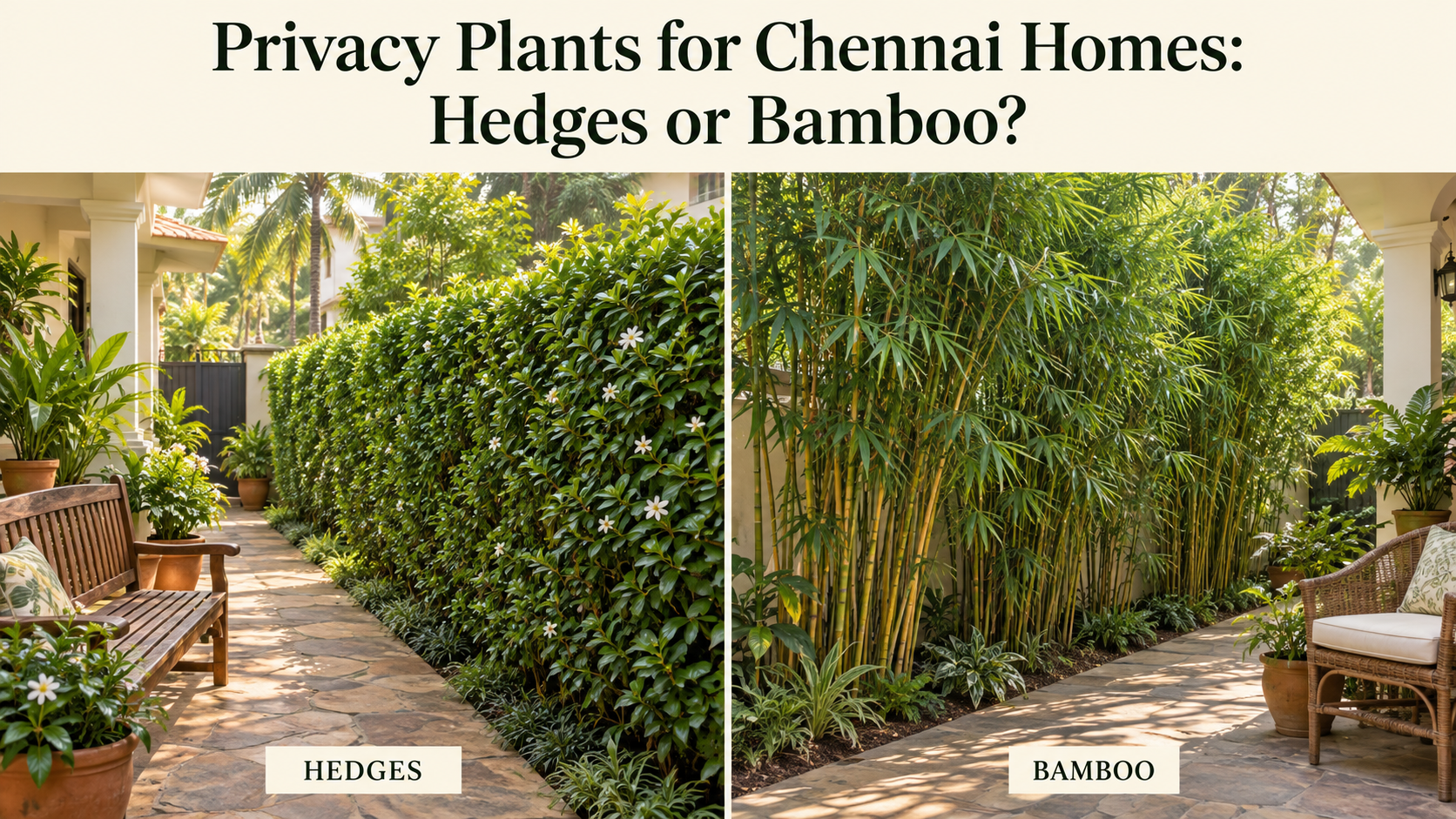
Privacy Plants for Chennai Homes: Hedges or Bamboo?
hoosing privacy plants for Chennai homes starts with understanding the view you want to screen. Do you want to make a front garden feel less exposed, hide a nearby service area, or create a quieter-looking corner for outdoor seating?
A clipped hedge can provide a defined green boundary. A suitable clumping bamboo can create a taller, more informal screen. However, neither is the right choice for every property.
The useful comparison is not simply “Which grows faster?” It is “Which plant can provide the privacy I need within the space and maintenance time I have?”
This guide explains seven decisions that will help you choose between hedges and bamboo, with plant examples and practical questions to discuss before buying.
Hedges or Bamboo: The Main Difference
A hedge is a planting arrangement, usually formed by growing shrubs or trees together. Bamboo is a group of plants, some of which can also be managed as a hedge.
For this comparison, “hedge” means a shrub-based screen, while “bamboo” means a bamboo-based screen.
| Consideration | Shrub hedge | Bamboo screen |
|---|---|---|
| Appearance | Can be formal and clipped or loose and flowering | Usually upright or arching, with visible canes and moving foliage |
| Screening near ground level | Depends on species and pruning | Depends on cultivar and lower branching |
| Height control | Usually maintained through species-appropriate pruning | Requires a plan for existing canes and new shoots |
| Space requirement | Mature width plus maintenance access | Mature clump width, foliage spread and access |
| Main maintenance | Trimming, watering and plant-health checks | Thinning, managing expansion, watering and leaf cleanup |
| Important buying detail | Exact species and cultivar | Exact species, cultivar and running or clumping habit |
| Typical mistake | Choosing a plant that must be cut constantly to fit | Assuming all bamboo stays narrow and contained |
Both options need a suitable growing position. A plant that survives in a space does not necessarily form an attractive, dense privacy screen there.
1. Decide Exactly Where You Need Privacy
Stand or sit in the place you want to protect before deciding how tall the planting should be.
Privacy for a seated person may require less screening than privacy at a bedroom window. A view from an upper-floor neighbouring building presents a different challenge from a view through a ground-level gate.
Check the sightline from several positions:
- Your normal seating location.
- The house entrance.
- Frequently used windows.
- The main garden path.
- The boundary where the screen is proposed.
Mark the area that actually needs screening. You may discover that a short section of planting is enough.
Avoid planting an unnecessarily tall screen along the entire boundary. It may create maintenance work or reduce light without improving the privacy you wanted.
A designer can help you assess whether planting alone is suitable or whether a combination of planting and a properly planned screen would work better.
2. Choose Plants for the Available Width
Height attracts attention at the nursery, but width often decides whether privacy planting works at home.
Measure the planting bed, the adjoining path and the space needed to maintain the screen. Include the mature foliage, not just the position of the stems.
Ask:
- Can the plant grow without covering the walkway?
- Will you be able to trim the boundary-facing side?
- Are drains, meters or inspection covers nearby?
- Will growth extend into a neighbour’s property?
- Is there enough root space beneath the visible planting strip?
Do not squeeze a large plant into a narrow bed just because it is currently sold in a small pot.
If the available space is very restricted, reconsider the planting strategy. A smaller plant combined with another screening element may be more practical than repeatedly cutting back an oversized hedge or bamboo clump.
3. Understand Running and Clumping Bamboo
Before purchasing bamboo, confirm its botanical name and growth habit.
Running bamboo spreads through underground stems called rhizomes. New shoots can appear away from the original planting. Clumping bamboo generally produces new canes closer to the established clump.
The Royal Horticultural Society’s bamboo control guide explains why identifying this growth habit matters and why unwanted bamboo can be difficult to remove.
Clumping does not mean that a plant will remain the size of its nursery container. The clump and overhead foliage still need room.
For a home boundary, avoid buying an unidentified plant labelled only “bamboo” or “screening bamboo.” Ask for the species and cultivar in writing.
If a supplier proposes a running type, request a clear explanation of containment and ongoing inspection. Do not assume a decorative edging strip will manage underground spread.
4. Compare Two Plant Examples
These examples illustrate the difference between a flowering shrub screen and clumping bamboo. They are candidates for site assessment, not universal recommendations for every Chennai property.
Hibiscus for a Flowering Shrub Hedge
Botanical name: Hibiscus rosa-sinensis
Hibiscus is a tropical evergreen shrub that can be grown as a hedge or screen. It can suit a homeowner who wants flowers as well as a green boundary.
NC State Extension describes it as suitable for sun to partial shade, with moist, well-drained soil. Its Hibiscus rosa-sinensis profile also highlights the need to allow for mature spread.
Choose the cultivar carefully. A compact ornamental selection and a larger-growing shrub will not create the same screen.
Discuss the balance between flowers and frequent clipping. Repeated trimming can remove developing growth and buds, so the maintenance approach should match your priorities.
Consider it when: You want a shrub-based boundary and can provide suitable light, space and regular care.
Hedge Bamboo for a Taller Green Screen
Botanical name: Bambusa multiplex
Bambusa multiplex is a clumping bamboo used for hedging and privacy screening. Its foliage and arching canes create a different appearance from a clipped shrub hedge.
NC State Extension’s Bambusa multiplex profile records a dense growth habit and several cultivars. Mature size varies, so the cultivar name is important.
Do not interpret a nursery label such as “dwarf bamboo” as a guarantee that the plant will suit a small bed. Ask about its expected dimensions and management under local conditions.
Also inspect where foliage begins on the canes. A tall plant may not give the low-level screening you need.
Consider it when: You want a bamboo screen and have room for the selected cultivar’s mature clump and foliage.
5. Check Sunlight, Drainage and Watering
Observe the proposed planting strip at different times of day. A boundary wall may cast substantial shade, even when the rest of the garden looks sunny.
Tell the nursery or designer how much direct light reaches the bed. Also mention reflected heat, exposure to wind and any recurring standing water.
A privacy screen is a continuous planting, so uneven conditions along the row can create uneven growth. One end may receive more sun or drain differently from the other.
Before planting, assess the whole strip rather than checking only one planting hole.
The RHS hedge planting guide emphasises preparation, species-dependent spacing and establishment care. Its UK planting calendar should not be copied directly into a Chennai garden.
For local layout considerations, read Win Landscape’s garden drainage guide for Chennai.
6. Choose a Maintenance Routine You Can Manage
Privacy planting is not a one-time installation.
A formal hedge needs a plan to retain its intended shape. A bamboo screen needs a plan for managing canes, foliage and the space occupied by the clump.
Before choosing, decide who will do the work. Will you maintain the planting yourself, employ a gardener or arrange scheduled visits?
Discuss:
- The desired finished height and width.
- How maintenance will be carried out from your side.
- Access for removing cut material.
- Watering during establishment.
- How gaps or unhealthy plants will be handled.
- What happens when the screen reaches its intended size.
Avoid choosing the fastest-growing option solely to obtain early privacy. Fast growth can also mean more work to keep the planting within its allotted space.
Our guide to low-maintenance gardens in Chennai offers broader ideas for matching a garden to your available time.
7. Set a Realistic Budget and Screening Timeline
There is no reliable promise that every hedge or bamboo screen will become fully private within a fixed number of months.
The outcome depends on the species, cultivar, starting size, plant quality, spacing, site conditions and aftercare.
Ask your landscaper to separate two milestones:
Establishment: The plants settle into the site and show healthy growth.
Effective screening: The planting provides useful coverage at the height and angle you need.
A taller nursery plant is not automatically a denser screen. Inspect the lower branches, root condition and overall shape before paying extra for size.
Request an itemised quotation covering plants, preparation, irrigation, any justified containment work, installation and maintenance.
If privacy is needed immediately, discuss a suitable temporary or permanent screening element while the plants develop. Do not overcrowd the bed simply to hide gaps on planting day.
Which Option Fits Your Home?
Use this table to guide an initial conversation with your designer.
| Your priority | Starting option to assess | Important condition |
|---|---|---|
| A defined, clipped boundary | A shrub hedge | Species must tolerate the intended maintenance |
| Flowers and greenery | A suitable flowering hedge | Allow for the relationship between pruning and flowering |
| A taller bamboo appearance | An identified clumping bamboo cultivar | Provide adequate mature width and access |
| Privacy close to the ground | A plant with suitable lower foliage | Check actual growth habit and pruning history |
| A very narrow planting strip | Reassess the whole screening design | Neither option should be forced into insufficient space |
| Immediate, reliable coverage | A screen combined with planting | Plant growth alone cannot guarantee instant privacy |
For privacy plants for Chennai homes, the best answer is often a specific plant in a specific position—not a general choice between “all hedges” and “all bamboo.”
Planning a Screen Near a Compound Wall
A wall does not remove the need to plan the planting bed.
Keep utility points, drainage access and regular inspection routes reachable. Ask the designer to account for the mature plant footprint and maintenance space.
Avoid assuming one fixed planting distance is suitable for every species. The correct setback depends on the plant, wall, services and site layout.
Before work begins, agree on which side of the planting will be maintained and how access will be provided. Do not rely on entering a neighbouring property to carry out routine care.
For a coordinated boundary plan, explore Win Landscape’s landscaping services in Chennai.
Can You Grow a Privacy Screen in Containers?
Containers may be an option where ground planting is unavailable, but they introduce their own limits.
Ask whether the selected plant can be managed long-term in the proposed container. Consider root space, watering, drainage, stability and future repotting or division.
A tall plant in a small decorative pot is not a complete screening solution.
For balconies and terraces, also assess the wet weight of the container, growing medium and plant, along with wind exposure and drainage. Obtain appropriate building advice where necessary.
Do not assume that raising a planter beside a railing automatically makes it a suitable privacy screen. Plan its position around safe movement and the intended use of the balcony.
A Practical Before-You-Buy Checklist
Take the following information to your nursery or landscape consultation:
- Photographs from the position where you need privacy.
- Approximate length and width of the planting area.
- Desired screening height.
- Available sunlight.
- Existing drainage or watering problems.
- Nearby paving, walls and underground services.
- Your maintenance budget and available access.
- Whether you need immediate coverage.
Ask for the full botanical name and cultivar of every proposed plant. Request photographs of mature examples where possible, while recognising that another site may have different conditions.
A clear brief makes plant selection more useful than asking only for “the best privacy plant.”
Mistakes That Can Lead to Disappointing Results
Buying Height Instead of Useful Coverage
Check the view through the plant at seated and standing eye level. Tall canes or stems may still leave gaps where you want privacy.
Planting Too Closely
Extra plants do not guarantee a better long-term screen. Ask for spacing based on the species, supplied size and intended form.
Assuming Every Bamboo Is Contained
Confirm its identity and growth habit. Do not treat an unidentified bamboo as a suitable boundary plant.
Ignoring Maintenance Access
A screen that cannot be reached comfortably becomes harder to manage as it matures.
Choosing from a Photograph Alone
A photograph rarely shows root space, cultivar identity, seasonal conditions or the maintenance needed to keep that appearance.
Expecting Soundproofing
A visual screen can make a garden feel more private, but a typical narrow planting strip should not be sold as a soundproof barrier.
Need expert help? Win Landscape offers professional residential landscaping and home gardening services in Chennai, along with complete landscaping services across the city. Book a free site visit to discuss your garden.
Frequently Asked Questions
What are suitable privacy plants for Chennai homes?
Suitable choices depend on sunlight, bed width, exposure and the required screening height. Hibiscus and selected clumping bamboo cultivars are examples to assess. Neither should be chosen without checking the actual site.
Is bamboo better than a hedge?
Bamboo may suit a taller, informal screen, while a shrub hedge may suit a more defined boundary. Compare mature width, lower-level coverage and maintenance rather than choosing by growth speed alone.
Does clumping bamboo spread?
The clump can expand as it produces new growth. Its growth pattern differs from running bamboo, but it still needs adequate space and management.
Can a hedge provide privacy from an upstairs window?
It may not be the most practical solution. Assess the sightline first. A plant tall enough to block an elevated view may occupy more space or require more maintenance than expected.
How far apart should privacy plants be planted?
Spacing depends on the exact species, cultivar, plant size and intended screen. Avoid using one standard spacing figure for every hedge or bamboo.
How quickly will the planting provide privacy?
There is no universal timeline. Ask for a site-specific estimate and distinguish healthy establishment from the point at which the screen gives useful coverage.
Which option needs less maintenance?
It depends on the plant and the finish you expect. A tightly clipped hedge has different requirements from an informal shrub screen or a managed bamboo clump.
Are these plants suitable for an exposed ECR property?
Coastal exposure needs a separate assessment. Suitability for Chennai’s general climate does not automatically establish tolerance to direct salt spray, strong wind or saline irrigation water.
Plan Privacy Around Your Space
The right privacy plants for Chennai homes should screen the view you want to soften while leaving room to walk, maintain the garden and enjoy natural light.
Start with the sightline and available width. Then choose an identified plant, agree on its maintained size and plan the care it will need.
Win Landscape can help you discuss planting layouts and garden maintenance requirements. Contact the team with photographs and approximate dimensions to explore a privacy planting plan for your home.