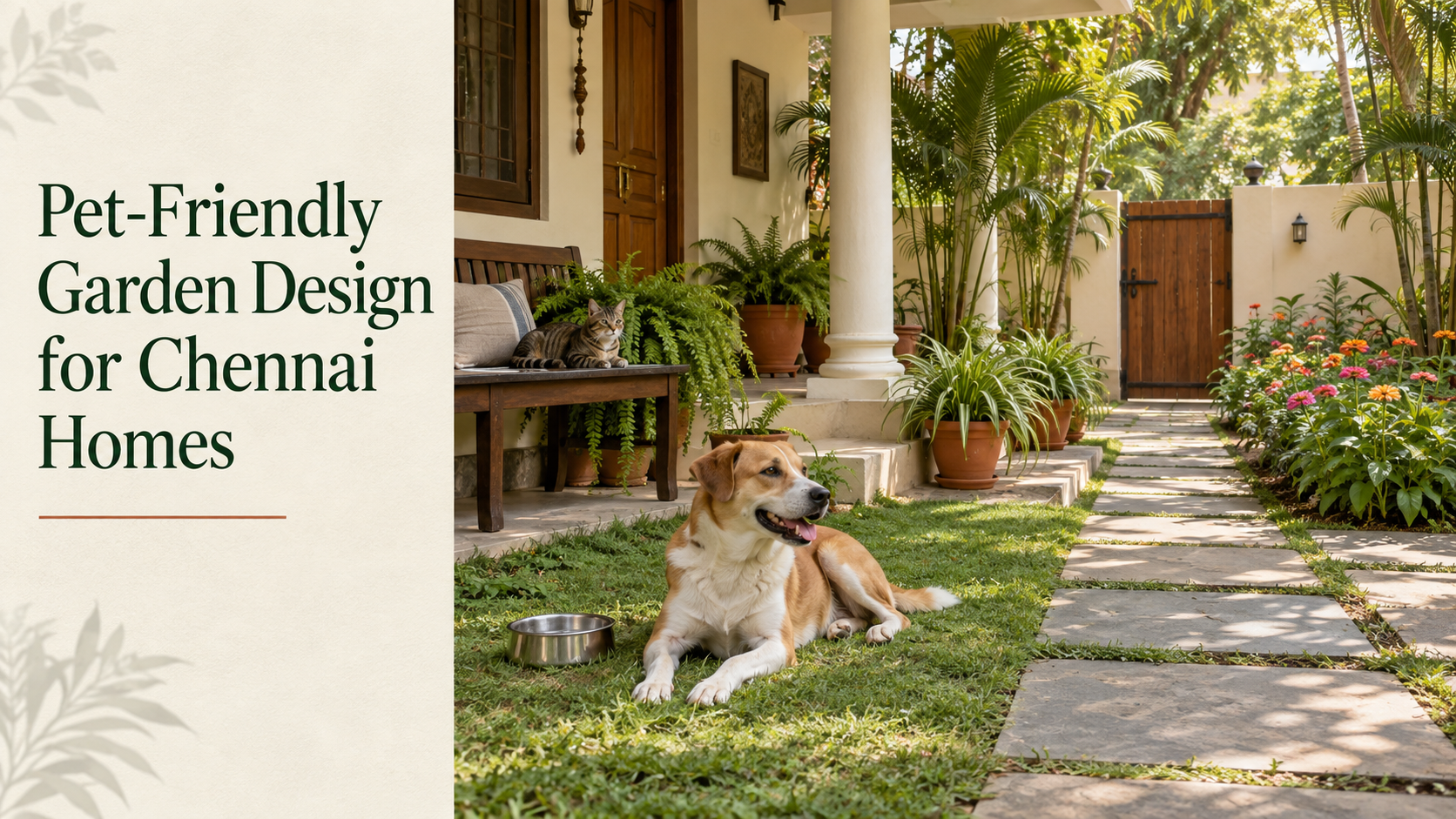
Pet-Friendly Garden Design for Chennai Homes
A garden should be a comfortable place for everyone in the household—including the dog who enjoys exploring and the cat who likes watching the world from a quiet corner.
Good pet-friendly garden design brings together suitable plants, shade, secure boundaries and surfaces that are practical to use and clean.
For Chennai homes, start by checking where the garden receives direct sun, how warm exposed surfaces become and where rainwater collects. Then consider your pet’s behaviour.
A puppy that chews leaves needs a different layout from an older dog with limited mobility. A climbing cat needs different boundaries from a dog that digs beneath a gate.
These seven planning steps will help you make more informed choices.
1. Start With Your Pet’s Habits
Before selecting plants or paving, spend time watching how your pet uses the existing space.
Does your dog follow the same route beside the compound wall? Does your cat climb through the planters? Is there a favourite resting spot near the door?
Use these observations to guide the layout.
Make a simple list
Record whether your pet:
- Chews leaves, sticks or loose objects.
- Digs in planting beds.
- Runs repeatedly along a particular route.
- Jumps onto furniture or raised planters.
- Tries to escape when the gate opens.
- Struggles with steps or slippery surfaces.
Keep the main movement route clear. Place delicate planting away from busy corners and allow enough space for your pet to turn without brushing against sharp edging.
Plan for changes over time
A small puppy may eventually jump higher or push through an opening that seemed secure.
Similarly, an ageing pet may benefit from a shorter route between the house, resting area and toilet spot.
Pet-friendly garden design works best when it supports everyday behaviour rather than depending entirely on training to protect the layout.
2. Check Every Plant by Its Botanical Name
Choosing plants requires more than asking whether they are “natural” or “commonly used.”
Common names can refer to different plants. Ask the nursery for the botanical name and check it against an authoritative toxicity reference for your animal.
The ASPCA’s toxic and non-toxic plant database is a useful starting point. Its list is not exhaustive, and even plants classified as non-toxic can cause stomach upset when eaten.
Two plants to consider after checking site suitability
| Plant | Botanical name listed by ASPCA | Toxicity classification |
|---|---|---|
| Areca palm | Dypsis lutescens | Non-toxic to dogs and cats |
| Spider plant | Chlorophytum comosum | Non-toxic to dogs and cats |
The classifications are supported by the ASPCA’s individual profiles for areca palm and spider plant.
These are options to assess, not a complete planting scheme. Confirm their light requirements, mature size and suitability for the exact position before buying.
“Non-toxic” does not mean a plant should become a chew toy or food source.
Plants that deserve particular attention
Sago palm — Cycas revoluta
Do not confuse sago palm with areca palm. Sago palm is toxic to dogs and cats, and ingestion can be life-threatening. Check existing cycads before allowing pets access. ASPCA sago palm profile
Oleander — Nerium oleander
Oleander is toxic to dogs and cats. Avoid including it in areas where pets can reach the plant or fallen material. ASPCA oleander profile
True lilies and daylilies
For homes with cats, avoid Lilium and Hemerocallis species. Exposure to plant parts, pollen or vase water can cause severe poisoning. The FDA’s guidance on lilies and cats explains the risk.
Check more than the newly planted beds
Include existing pots, hanging baskets, bouquets, fallen seeds and plants growing through the boundary from outside.
An elevated pot is not necessarily inaccessible to a cat.
If you suspect poisoning, contact a local veterinarian immediately. Photograph the plant and keep its label if available. Do not wait for symptoms before seeking advice.
3. Provide Shade, Water and Access Indoors
Shade should be part of the initial layout.
Observe the proposed resting area at several times of day. A corner shaded in the morning may receive direct afternoon sun.
Make the resting area practical
Provide:
- Reliable shade.
- Air movement.
- A comfortable resting surface.
- Fresh drinking water in a stable bowl.
- An easy route back indoors.
An open pergola may provide only partial shade, depending on its roof arrangement and the sun’s position. Check the actual coverage rather than relying on its appearance.
During hot weather, limit strenuous outdoor activity and keep pets in a comfortable environment. The ASPCA’s hot-weather guidance recommends shade, fresh water and precautions against hot surfaces.
Shade alone does not make prolonged outdoor exposure safe.
Separate drinking water from garden features
Give pets a dedicated drinking bowl rather than relying on a pond, fountain or irrigation tray.
Position the bowl where it stays clean and is easy to refill. Avoid placing it directly beneath falling leaves or beside the toilet area.
4. Choose Surfaces for Grip, Comfort and Cleaning
The best surface depends on how your pet uses it.
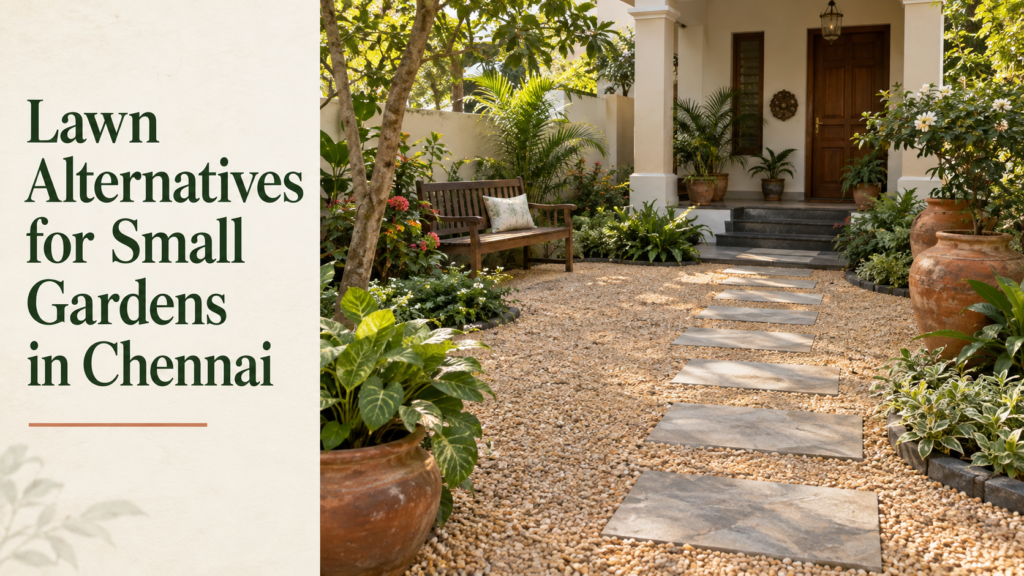
Compare samples in the actual garden. Consider wet-weather grip, exposed edges, cleaning and how the surface behaves in direct sun.
| Surface | Potential use | What to check |
|---|---|---|
| Natural lawn | Resting and supervised activity | Wear, muddy patches and maintenance products |
| Outdoor paving | Main routes and cleaning access | Grip, temperature, joints and edges |
| Loose gravel | Selected decorative areas | Whether your pet mouths stones or dislikes the texture |
| Artificial turf | Areas where owners want a green manufactured surface | Heat, drainage, cleaning and repair |
| Planted groundcover | Decorative borders | Exact plant toxicity and tolerance of traffic |
No material is automatically suitable for every dog or cat.
Keep busy routes firm and even
Avoid loose slabs, sharp metal edging and gaps that could catch a paw.
For pets with mobility difficulties, minimise awkward steps and abrupt changes in level. Seek veterinary advice if your pet needs specific mobility support.
Think carefully about artificial turf
Artificial turf removes mowing, but it still needs cleaning and a suitable drainage system.
Ask the installer how urine will drain through the full construction, how the surface should be cleaned and how it performs in direct sun.
“Pet-friendly” on a product label should lead to specific questions about maintenance and use—not end the assessment.
5. Design Boundaries Around Dogs and Cats Separately
A decorative boundary is not necessarily a secure pet enclosure.
Walk around the garden at your pet’s level and inspect gates, gaps, loose panels and spaces beneath fencing.
For dogs
Check whether the dog can:
- Push through or beneath an opening.
- Dig under the boundary.
- Use a planter or chair as a step.
- Reach the street when someone opens the gate.
A separate internal gate can create a buffer near a frequently used entrance, where space allows.
Choose the boundary arrangement for your dog’s size and behaviour. There is no single fence height that contains every dog.
For cats
Cats may climb ordinary garden fencing. An enclosed outdoor run or “catio” can provide controlled outdoor access when properly designed.
Assess the roof, sides, doors and attachment points as one enclosure.
For balconies, use purpose-designed containment that is securely installed and checked regularly. Do not assume ordinary insect screening or loose netting will contain a cat.
Keep pots stable
Place heavy or tall containers where they cannot easily tip when brushed or climbed on.
Keep planters away from balcony edges and routes where a running pet could knock them over.
For related space-planning ideas, explore Win Landscape’s guide to balcony gardens in Chennai.
6. Plan Drainage and a Manageable Toilet Area
A garden that is easy to clean is more practical for both pets and people.
Choose a toilet area you can reach without crossing delicate planting. Keep it separate from seating and edible crops where possible.
Start with your pet’s preferences
Observe the surface your dog already uses. A sudden change from grass to an unfamiliar material may need patient training.
Do not assume that every pet will immediately use a new corner because it has been labelled as the toilet area.
Make cleaning straightforward
Keep waste bags and cleaning equipment accessible to adults but away from pets.
Remove solid waste promptly. Follow product instructions when cleaning surfaces, including any restrictions on pet access.
Avoid directing contaminated wash water into planting beds or onto neighbouring property.
Fix standing-water problems
Check low spots, blocked drains and irrigation leaks before completing the layout.
Win Landscape’s guide to garden drainage in Chennai covers a related part of outdoor planning.
Ponds, tanks and deep water features need separate access controls. Do not assume that every pet can swim or climb out.
7. Build Pet Safety Into Garden Maintenance
A suitable plant list is only one part of pet-friendly garden design.
The garden also contains tools, treatments, packaging, irrigation parts and loose material.
Store products securely
Keep fertilisers, pesticides, rodent-control products and cleaning chemicals in their original labelled containers, inside secure storage.
After any treatment, follow the product’s directions for keeping pets away and allowing re-entry. There is no universal waiting period suitable for every garden product.
“Organic” or “natural” should not be treated as a guarantee of pet safety.
Inspect after gardening work
Before pets return to the area:
- Collect pruning waste.
- Remove loose wire, ties and packaging.
- Put tools away.
- Check displaced edging and irrigation fittings.
- Confirm that gates are latched.
Tell anyone maintaining the garden that pets use the space.
For ongoing care planning, read Win Landscape’s guide to professional landscape maintenance in Chennai.
A Simple Layout for a Small Chennai Garden
A compact garden can support pets without becoming crowded.
An illustrative layout could include:
- A clear route from the house to the garden gate.
- A shaded resting spot near the house.
- A small activity area.
- Planting along protected edges.
- A toilet area that is easy to maintain.
- Secure storage for garden products.
This is a planning example, not a fixed design. Adjust it to the space, sunlight and your pet’s behaviour.
Keep sightlines open enough to supervise activity from the house where practical.
Common Mistakes to Avoid
Choosing plants by common name alone
Confirm the botanical name and check toxicity for the relevant animal.
Assuming raised planting is unreachable
Cats climb, and fallen leaves or seeds can reach the ground.
Selecting surfaces only by appearance
Check grip, exposed edges, temperature and cleaning needs.
Leaving shade until the end
Plan it early and check how it changes through the day.
Treating all pets alike
A chewing puppy, an elderly dog and a climbing cat need different arrangements.
Forgetting maintenance products
A carefully planted garden can still present risks if treatments and tools are accessible.
Need expert help? Win Landscape offers professional residential landscaping and home gardening services in Chennai, along with complete landscaping services across the city. Book a free site visit to discuss your garden.
Frequently Asked Questions
What makes a garden pet-friendly?
It combines appropriate plant choices, secure boundaries, comfortable shade, practical surfaces and a manageable maintenance routine. Supervision remains important.
Are all palm plants safe for pets?
No. Areca palm is listed as non-toxic to dogs and cats, while sago palm is toxic. Always check the exact botanical name.
Can I have a pet-friendly garden without a lawn?
Yes. A mix of suitable planting, comfortable resting space and practical paths may work well. Choose surfaces for your pet’s behaviour and needs.
Is artificial grass the best option for dogs?
Not automatically. Compare temperature, drainage, cleaning and the dog’s comfort with other options before deciding.
Can a balcony become a cat-friendly garden?
Yes, with appropriate containment, stable planting and supervised use. A railing or ordinary screen alone should not be assumed sufficient.
What should I do if my pet eats an unknown plant?
Contact a veterinarian promptly and provide a photograph or plant label. Do not try home treatments unless the veterinarian directs you.
Plan a Garden That Works for Your Household
A thoughtful garden gives pets room to explore while making supervision, cleaning and everyday care easier.
Start with your pet’s habits, verify the plants and plan shade and boundaries before adding decorative features.
Explore Win Landscape’s landscaping services or contact Win Landscape to discuss a garden layout for your Chennai home. Share your pet’s size, age and behaviour as part of the design brief.