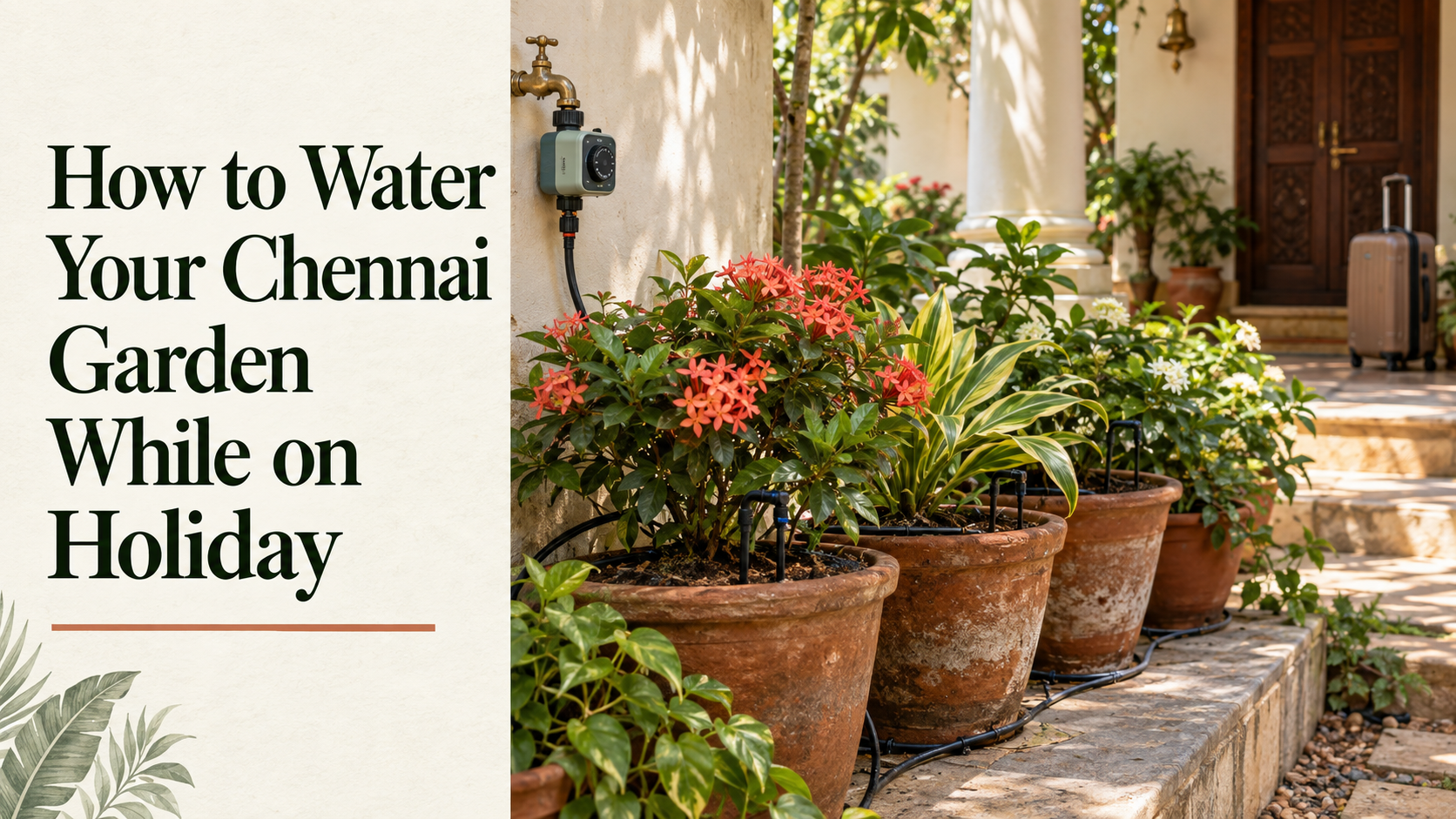
How to Water Your Chennai Garden While on Holiday
Planning garden watering while on holiday should start before you pack your bags. A few terrace pots, a newly planted hedge and an established garden bed can need very different care while you are away.
For a Chennai home, the right arrangement depends on the plants, their exposure, your water supply and the length of your trip. A timer can help, but it cannot refill an empty tank or repair a leaking connection.
The most dependable plan combines a watering method you have already tested with clear instructions for someone who can check the garden.
Here are seven practical steps to help you prepare.
Garden Watering While on Holiday: Which Method Fits?
Start with the plants you have rather than buying a watering device first.
| Method | Where it may help | What to confirm before leaving |
|---|---|---|
| Drip irrigation with a timer | Planting beds, shrubs and groups of containers | Water supply, pressure, delivery and automatic operation |
| Existing sprinkler system | A lawn already served by a suitable installation | Coverage, weather adjustments and drainage |
| Self-watering containers | Suitable plants already growing in reservoir pots | Reservoir capacity and actual refill interval |
| Tested wick system | A small number of compatible containers | Water transfer, reservoir position and plant response |
| Caretaker or gardener | Mixed gardens, sensitive plants and longer trips | Access, written instructions and emergency contact |
You may need more than one method. An established planting bed and small hanging baskets should not automatically share the same care plan.
1. Identify the Plants That Need the Most Attention
Walk around your garden and make a short inventory.
Include terrace containers, hanging baskets, young plants, vegetable beds and any plants growing under a roof. These are easy to overlook when you think only about the main garden.
For each group, note:
- Its location.
- Whether it receives direct sun or wind.
- Whether rain reaches it.
- How quickly the soil or potting mix normally dries.
- Whether it has been planted or repotted recently.
- Any existing watering problems.
The Royal Horticultural Society explains that watering needs vary with weather, soil, plant size and establishment stage. Its guide to watering plants supports checking actual conditions rather than following one fixed schedule.
Use those general principles for your Chennai garden, rather than copying the guide’s UK seasonal calendar.
Give priority to plants that already need frequent attention. Do not assume that a plant labelled drought tolerant can be left without care immediately after planting.
2. Test Drip Irrigation Before Relying on It
Drip irrigation can help deliver water to selected planting areas without requiring someone to move a hose around the garden.
A timer controls when the system runs. The outlets, tubing and layout determine where the water actually goes.
The US Environmental Protection Agency’s microirrigation guide explains how this method supplies water slowly to the root zone.
For holiday use, carry out a practical trial before departure:
- Run the complete programme.
- Check each planting area and container.
- Look for leaks, disconnected tubing and blocked outlets.
- Confirm that water reaches the intended root area.
- Check moisture again between watering cycles.
- Adjust the programme based on what you observe.
A timer showing “watering complete” does not prove that every plant received water.
Test the automatic schedule as well as the manual start button. A system that works when switched on by hand may still have an incorrect programme or clock setting.
For background on installation and equipment, read Win Landscape’s drip irrigation guide for Chennai gardens.
3. Confirm the Water Supply and Power Arrangements
Before leaving, trace the system from its water source to the plants.
Does it depend on an overhead tank, a pump or a regularly available supply? Does the tank refill automatically? What happens if the power fails?
Check the operating instructions for your specific equipment. A battery-operated timer may still control a system that depends on an electric pump.
Also confirm:
- The supply valve is in the required position.
- Batteries are in good condition, where applicable.
- The controller retains the intended settings.
- A caretaker knows how to pause the system.
- The water source can support the planned operation.
- Any app-based controls remain usable under the expected conditions.
A Wi-Fi connection is not a substitute for understanding the equipment. Some controllers operate stored programmes without internet access; others have functions that depend on connectivity. Verify your model rather than assuming.
Label the irrigation shut-off clearly so someone can stop a leak without searching around the property.
4. Use Self-Watering Pots Only After a Trial
Self-watering containers store water in a reservoir and supply moisture through their designed watering arrangement.
They can be useful for suitable plants, but the word “self-watering” does not mean they can be ignored indefinitely.
How long a reservoir lasts depends on its usable capacity, the plant, the growing medium and the conditions around the container.
Before your trip:
- Check how the planter is intended to be filled.
- Observe the water-level indicator, if fitted.
- Measure how quickly the reservoir empties.
- Confirm that overflow and drainage openings function.
- Arrange refilling before the reservoir runs dry.
Avoid moving a plant into an unfamiliar container immediately before leaving. Allow time to observe how it responds.
The RHS container maintenance guide explains why container plants depend on careful watering and protection from both drying out and excessive moisture.
For improvised wick systems or bottle devices, test each setup with the actual pot. Do not rely on a general claim that one bottle will water every plant for a week.
5. Reduce Unnecessary Exposure Without Removing Needed Light
If movable containers sit in a particularly exposed position, consider whether a more sheltered location would suit them during your absence.
Keep their light requirements in mind. Moving every plant into a dark room is not a sensible substitute for watering.
Where appropriate, group containers by care needs and position them so a caretaker can reach them easily. Keep walking routes and drains clear.
Try any location change before the trip. Check whether the plants remain comfortable there and whether their watering needs have changed.
For garden beds, suitable mulch can help reduce moisture loss. Keep it away from direct contact with stems and do not cover irrigation fittings that need inspection.
These measures support a watering plan; they do not replace one.
6. Give Your Caretaker Specific Instructions
“Please water the plants” leaves too much room for guesswork.
Create a short guide using photographs and labels. Group plants into areas such as “Terrace Pots,” “Front Border” and “Covered Balcony.”
For each area, explain what to check and what action to take. Where the instructions depend on soil moisture, demonstrate the check before you leave.
A useful handover includes:
| Item | Information to leave |
|---|---|
| Plant locations | Labelled photographs or a simple map |
| Watering method | Hose, watering can, reservoir refill or automatic system |
| Decision rule | The plant-specific moisture check demonstrated beforehand |
| Automatic zones | Which areas already receive scheduled irrigation |
| Problems to report | Leaks, dry pots, pooling or unusual plant decline |
| Shut-off point | A clear photograph and location |
| Contact details | Your number and a local backup contact |
Ask the caretaker to avoid adding extra water to every plant simply because they are visiting. Plants already receiving automatic irrigation still need checks, but not necessarily additional watering.
A short photo update can help you identify a disconnected tube or missed container without changing the whole programme unnecessarily.
7. Arrange Backup Checks for Longer Absences
The longer you are away, the more opportunities there are for conditions to change.
Water supply interruptions, blocked outlets, heavy rain or a moved container can affect a system that worked correctly before departure.
Arrange visits according to the garden’s needs and the reliability of the equipment. A balcony with thirsty plants may require a different checking frequency from an established ground-level garden.
Ask the person checking to look at the garden itself, not only the controller screen.
They should confirm that:
- Water remains available.
- The programme is operating as intended.
- Plants are receiving water.
- There are no obvious leaks or overflowing containers.
- Drainage routes remain clear.
If a problem occurs, the backup plan should be simple: stop uncontrolled watering, take photographs and contact the agreed person.
For help planning irrigation and ongoing care, explore Win Landscape’s landscaping services in Chennai.
Match the Plan to the Length of Your Trip
Trip length is useful for planning, but it does not determine how long a plant can safely go without water.
| Absence | Preparation to consider |
|---|---|
| A weekend | Check moisture, identify vulnerable plants and confirm whether someone needs to visit |
| Several days | Use a tested watering arrangement and organise checks for plants needing closer attention |
| A week or more | Plan reservoir refills, system inspections and a reliable backup person |
| An extended trip | Agree on ongoing maintenance responsibilities and a clear response to failures |
Do not interpret this table as a no-watering allowance. Small pots in exposed conditions can need attention even during a short absence.
Likewise, adding more water before departure does not turn ordinary potting mix into a safe long-term reservoir.
Check the Lawn Separately
If your garden has a lawn, review its irrigation independently from the pots and shrub beds.
An existing sprinkler programme may need adjustment for current conditions. Watch it run before leaving and check that water stays within the intended area.
The EPA’s watering tips recommend reviewing schedules, inspecting equipment and correcting spray that reaches paving instead of plants.
Do not increase every runtime simply because you will be away. First check what the existing programme delivers and whether the soil is remaining appropriately moist.
Newly laid turf requires a different establishment plan from an established lawn. If the lawn is new, obtain specific care instructions and arrange someone to monitor it.
Do Not Rely on Rain Alone
Rainfall does not reach every part of a garden equally.
Containers under a portico, balcony roof or dense canopy may remain dry while the surrounding paving is wet. Other areas may receive concentrated runoff.
Before leaving, identify both sheltered pots and locations where water tends to collect.
Ask your caretaker to inspect these areas separately after rain. Automatic irrigation may need pausing or adjustment, depending on the conditions and controller.
If water regularly pools around planting or on the terrace, address the problem before travel. Win Landscape’s garden drainage guide for Chennai covers related planning considerations.
Estimate Reservoir Needs from Real Measurements
For a reservoir-fed system, measure actual consumption during a trial.
For example, suppose a setup uses 4 litres per day under the observed conditions. Seven days of similar operation would require:
4 litres × 7 days = 28 litres
That is a baseline calculation, not a guarantee. Weather, plant demand, leaks and unusable water remaining below the intake can change the result.
Choose equipment and a refill plan that account for these uncertainties. Keep reservoirs covered and maintain the overflow and ventilation arrangements specified by the manufacturer.
A full tank is useful only if water can reach the plants at the required flow and pressure.
A Practical Preparation Timeline
About a Week Before Departure
Inventory the plants and decide who will check them. Start testing any automatic or reservoir-based watering arrangement.
Repair existing faults while there is still time to confirm that the repair works.
Several Days Before Departure
Observe moisture between cycles. Check whether any pots are missed or remain too wet.
Prepare your labelled photographs and demonstrate the routine to your caretaker.
The Day Before Departure
Check the forecast, water supply, controller settings and reservoir levels. Adjust care to actual conditions rather than watering everything automatically.
Clear accessible drainage outlets and confirm the backup contact.
On Departure Day
Make one final visual check. Confirm that the intended programme is active and that access arrangements work.
Avoid introducing an untested device or making a major schedule change at the last minute.
Mistakes to Avoid
Leaving every pot standing in water: This can keep unsuitable plants excessively wet. Use a reservoir system designed for the purpose rather than treating any bucket or saucer as one.
Testing only one emitter: Inspect the complete watering arrangement, including the furthest outlets.
Assuming automation needs no supervision: Equipment can fail even when the programme is correct.
Using the same schedule for all plants: Different containers, plants and locations can need different care.
Making major changes just before travel: New equipment and repotted plants need observation.
Leaving unclear instructions: A labelled photograph is often more useful than a long verbal explanation.
What to Do When You Return
Inspect the garden before changing the watering programme.
Check moisture, reservoir levels, leaks and the condition of the plants. Ask your caretaker whether anything unusual happened.
If a plant looks wilted, check the root-zone conditions before adding more water. Wilting does not always mean the soil is dry.
Restore moved containers thoughtfully and review what worked. Keep useful notes so the next trip requires less preparation.
If you travel regularly, a permanent arrangement with accessible controls and a documented maintenance routine may be worth discussing with a landscaper.
Need expert help? Win Landscape offers professional garden maintenance services in Chennai, along with complete landscaping services across the city. Book a free site visit to discuss your garden.
Frequently Asked Questions
What is the best method for garden watering while on holiday?
For many mixed gardens, a tested irrigation arrangement combined with human checks is a practical choice. A few pots may be manageable with a caretaker or suitable reservoir plan. The best method depends on the plants and site.
Can I leave my plants without water for a week?
There is no safe universal answer. Plant type, container size, exposure and weather all matter. Observe the actual plants and arrange care before they reach stress.
Will a drip timer work if the power goes off?
It depends on the timer and water supply. A battery timer may continue operating, but a pump-fed supply may still stop. Test the complete setup and check the equipment instructions.
Are watering bottles reliable for outdoor pots?
Their performance varies with the device, soil and installation. Test them with each pot before relying on them, and arrange backup checks.
Should I water heavily before leaving?
Water according to the plant’s needs and allow appropriate drainage. Excess watering does not safely compensate for a long absence.
Do self-watering pots suit every plant?
No. Suitability depends on the plant, growing medium and container design. Follow the planter instructions and observe performance before departure.
Should the caretaker water after it rains?
They should inspect the relevant plants first. Rain may miss covered pots while leaving other areas wet. The response should reflect actual moisture conditions.
Leave with a Tested Plan
Successful garden watering while on holiday depends on preparation rather than guesswork.
Know which plants need attention, test the equipment, confirm the water supply and leave clear instructions. Arrange someone who can respond if conditions change.
Win Landscape can help you discuss garden irrigation and maintenance requirements. Contact the team with photographs, details of your existing setup and your travel dates to explore suitable preparation.