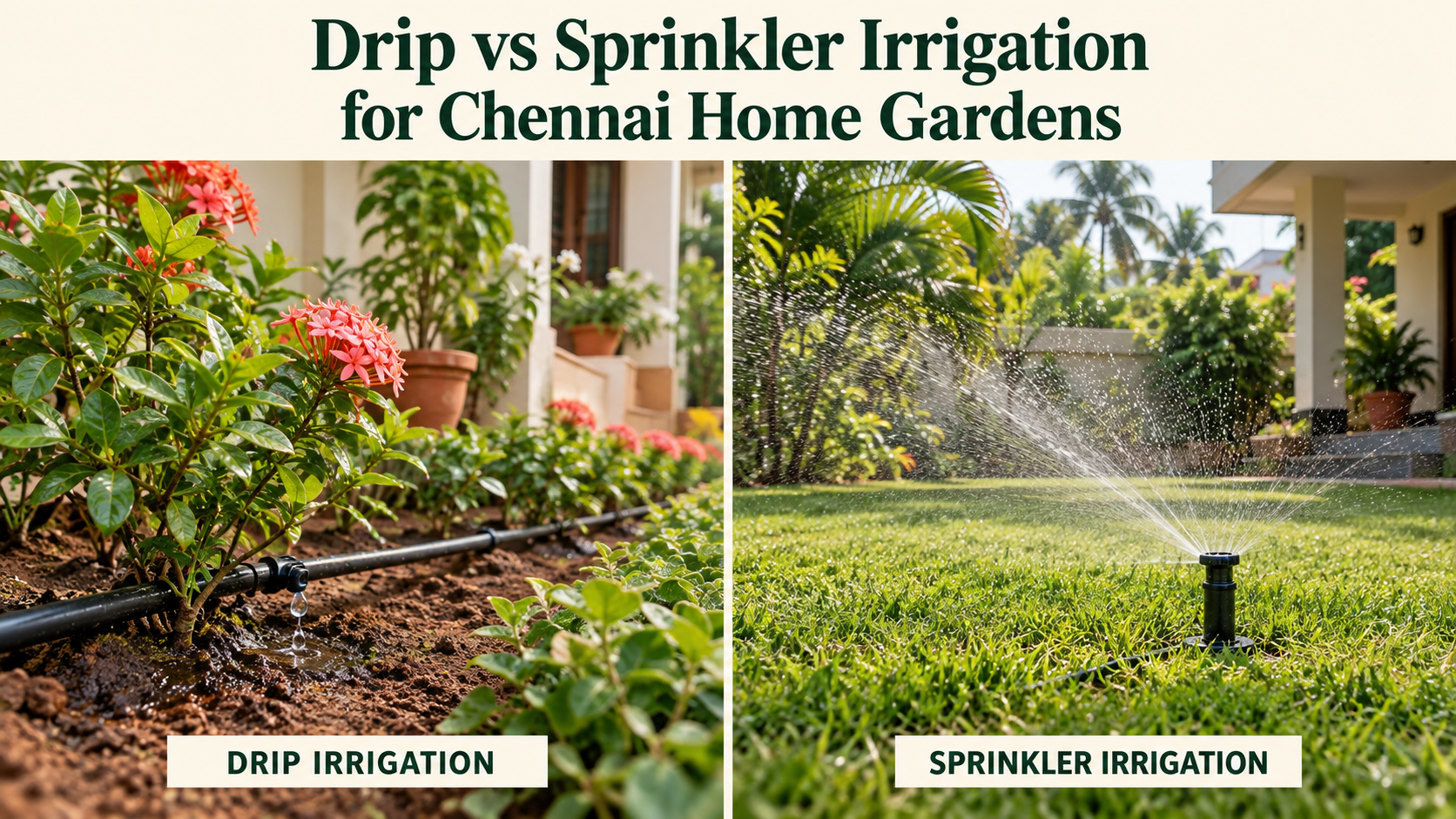
Drip vs Sprinkler Irrigation for Chennai Home Gardens
Choosing between drip vs sprinkler irrigation becomes easier when you look at what your garden actually needs. A row of balcony pots, a vegetable bed and a front lawn do not need to be watered in the same way.
For many home gardens, drip irrigation is a practical choice for individual plants and planting beds. Sprinklers are often useful for watering an open lawn. If your garden includes both, using separate irrigation zones may be the most sensible approach.
Before buying equipment, consider your plants, water supply, layout and maintenance routine. This guide explains the differences and gives you seven practical tips for planning an irrigation system for your Chennai home.
Drip vs Sprinkler Irrigation: A Quick Comparison
| Feature | Drip irrigation | Sprinkler irrigation |
|---|---|---|
| How water is delivered | Through emitters or dripline near the root zone | Through spray heads or rotating streams over an area |
| Common applications | Planting beds, shrubs, hedges and containers | Open lawns and suitable broad planting areas |
| What needs careful planning | Emitter placement, filtration and flow | Head spacing, pressure and coverage |
| Typical maintenance checks | Blocked emitters, damaged tubing and leaks | Blocked nozzles, damaged heads and misdirected spray |
| Main design risk | Some plants receive too little or too much water | Water misses the planting area or coverage is uneven |
| Automation | Can use compatible valves and controllers | Can use compatible valves and controllers |
| Mixed gardens | Usually best on its own watering zone | Usually best on a separate lawn zone |
Neither system works well simply because it has been installed. The equipment must suit the garden, and its operation needs to be checked.
How Drip Irrigation Works
Drip irrigation moves water through a network of pipes and smaller tubes. Emitters release water at selected points, while dripline has outlets arranged along the tubing.
The purpose is to wet the root zone instead of spraying the whole surrounding area. This makes it useful where plants occupy specific positions, such as a hedge beside a compound wall or containers along a terrace.
The US Environmental Protection Agency explains that microirrigation delivers water slowly and directly to the root zone. Its microirrigation guide describes how suitable design and maintenance can reduce unnecessary watering.
A drip system still needs attention. An emitter beside an empty patch of soil does not help a plant growing elsewhere. As plants grow or pots move, the watering arrangement may need adjustment.
For a closer introduction to the equipment and its uses, read Win Landscape’s drip irrigation guide for Chennai gardens.
How Sprinkler Irrigation Works
Sprinklers distribute water across an area through fixed sprays or rotating streams. Depending on the design, the heads may stand above the ground or rise from below the surface during watering.
They are commonly considered for lawns because grass covers a continuous area. However, a sprinkler must be selected and positioned to suit the shape of that area.
A square lawn, a narrow strip and an irregular garden corner need different coverage arrangements. Installing the same head everywhere can leave some sections dry while watering paths or walls.
Ask the installer to demonstrate the system while it is running. You should be able to see where the water lands, whether plants obstruct the spray and whether the pattern remains within the intended area.
1. Choose According to What You Are Growing
Start with a simple list of the areas in your garden:
- Lawn.
- Shrub or flower borders.
- Vegetable beds.
- Trees.
- Containers.
- Hanging baskets or wall-mounted planters.
Then consider each area separately.
For individual pots, drip irrigation allows you to direct water to the containers rather than the surrounding floor. For a hedge, a dripline arrangement may be easier to manage than a sprinkler spraying both the plants and the driveway.
For an open lawn, properly designed sprinklers may provide a more straightforward solution.
These are starting points rather than fixed rules. Specialist subsurface drip systems can also irrigate lawns, but they require a suitable design and maintenance plan. Ordinary surface tubing placed across grass is not the same thing.
When comparing drip vs sprinkler irrigation, ask which system fits the planting pattern instead of searching for one winner for every part of the property.
2. Check the Water Supply Before Choosing Equipment
Tell your installer where the irrigation water will come from. This may be a storage tank, a borewell, a pump-fed line or another suitable source.
Ask for the available pressure and flow to be checked under operating conditions. A supply that appears strong at one tap may behave differently when several outlets are running.
Useful questions include:
- Can the supply operate the proposed zone correctly?
- Will pressure change when other household water uses are active?
- Is a filter needed, and where will it be installed?
- Does the equipment require pressure regulation?
- Can the system be isolated easily for repairs?
Avoid buying equipment only because the connector fits your tap. Compatibility involves more than pipe size.
Water quality also deserves attention. Filtration and maintenance requirements should match the water source and the selected components. Ask the installer what must be checked and how often, rather than assuming that every filter follows the same cleaning schedule.
3. Plan Coverage Around the Shape of the Garden
Garden shape has a major influence on irrigation design.
Imagine a Chennai home with a small rectangular lawn, a narrow flower border and a paved route to the gate. One sprinkler placed in the middle may wet all three areas, even though only two need irrigation.
A better starting plan would be to assess the lawn and border separately.
For a drip layout, check that the arrangement serves the planted area rather than merely following the easiest route for the tubing. For sprinklers, ask how the design will cover corners without overspraying the pavement.
Before installation, request a simple drawing showing:
- Water source and control point.
- Main pipe routes.
- Watering zones.
- Sprinkler or emitter locations.
- Valves and accessible maintenance points.
Keep a copy of this drawing. It becomes useful when you add plants, change paving or need to find a buried pipe later.
4. Compare Water Use Through Measurement
Drip irrigation can be efficient in appropriate planting areas, but the name of the system does not tell you how much water your garden will use.
An oversized runtime, a leak or an unsuitable layout can waste water in either system.
A useful comparison starts with the flow delivered and the time the system operates. For an illustrative drip zone:
20 emitters × 2 litres per hour × 0.5 hour = 20 litres
This example assumes all emitters actually deliver their rated flow under the operating conditions. It is a calculation example, not a watering recommendation for your garden.
For a sprinkler zone, measured total flow multiplied by runtime gives its approximate water use. To compare the two fairly, you must also consider whether each method supplies the intended root zone adequately.
Ask your installer to explain the proposed operating time and how it will be adjusted. Avoid accepting an impressive water-saving percentage without a clear baseline or site measurements.
5. Separate Areas with Different Watering Needs
A lawn, newly planted shrubs and small containers may need different watering schedules. Connecting everything to one zone can make those differences difficult to manage.
A zone is simply an area controlled together. Separate zones let you adjust one part of the garden without changing the entire property’s schedule.
For example, an illustrative mixed garden could have:
| Zone | Garden area | System to assess |
|---|---|---|
| A | Open lawn | Sprinklers |
| B | Shrubs and flower borders | Drip irrigation |
| C | Containers | A separately controlled drip arrangement |
The final number of zones depends on the site and available water supply.
The EPA’s garden watering advice recommends considering plant type, exposure and irrigation equipment when grouping watering zones.
Ask the installer to label the controls clearly. Names such as “Front Lawn” and “Terrace Pots” are more useful to a homeowner than unexplained zone numbers.
6. Choose Maintenance You Can Keep Up With
Both systems need maintenance. The practical question is which checks you or your gardener can carry out reliably.
With drip irrigation, inspect the tubing and confirm that water reaches the intended plants. A system may look tidy while a blocked or displaced outlet leaves one container dry.
With sprinklers, watch for damaged heads, obstructed spray and water landing outside the garden. Plant growth can change the original coverage pattern over time.
Create a small maintenance record with three columns: date, problem and action taken. A phone note is enough.
Also ask where replacement parts can be obtained. A system that depends on unfamiliar components may become inconvenient if a small failure cannot be repaired promptly.
A good handover should include a demonstration, component details and clear instructions for switching the system off. Automation should make routine care easier, not make the equipment harder to understand.
7. Compare Complete Quotes, Not Just Installation Prices
There is no reliable single price for drip vs sprinkler irrigation across all Chennai homes. A few pots beside a tap and a large villa garden involve different work.
Ask for an itemised quote covering the relevant parts of the project:
- Pipes, fittings and outlets.
- Filtration and pressure control.
- Valves and controller.
- Pump-related work, if required.
- Installation and testing.
- Reinstatement of disturbed surfaces.
- Handover and maintenance support.
Then compare like-for-like proposals.
A lower quote may cover a manual system, while another includes automation and separate zones. Neither is automatically better; you need to understand what each proposal includes.
Ask who will adjust the system after planting changes and whether follow-up visits are included. Clear expectations help avoid a system that works on installation day but becomes difficult to manage later.
You can discuss your site requirements through Win Landscape’s landscaping services in Chennai.
Three Example Garden Layouts
These examples illustrate how to think about system choice. They are not completed project case studies or measured installation designs.
Example A: Balcony Pots and a Small Terrace Collection
A household has several pots of different sizes, with some under cover and others exposed to sun.
A drip arrangement is worth assessing, but all pots should not automatically receive identical watering. Ask how the design will account for differences in plant size, container size and exposure.
Keep tubing away from walking routes and confirm where excess water will drain. Test the setup before relying on it during a holiday.
The main decision is whether automation meaningfully simplifies care. For a very small collection, careful manual watering may remain a practical option.
Example B: Front Lawn with a Planted Boundary
A home has an open lawn surrounded by shrubs.
Assess sprinklers for the grass and drip irrigation for the boundary planting. Position and control them so watering the lawn does not repeatedly soak the driveway.
Ask how maintenance access will work when the shrubs become larger. Also identify where gardening tools or future digging could damage pipes.
This layout shows why choosing one method for an entire property may be less useful than assigning each method to the area it serves well.
Example C: A Larger Garden with Changing Planting
A homeowner plans to add trees, vegetable beds and seating over time.
Start with a plan that identifies likely future changes. Ask which parts of the system can be extended and which would need redesign.
Do not assume spare pipe alone makes an installation expandable. Water supply, controls and zone capacity also need consideration.
A phased installation may be practical, provided the first stage is designed with the later stages in mind. Keep the drawing updated as work progresses.
Set Watering Times by Need, Not Habit
Avoid copying a fixed schedule from another garden. Plants, soil, containers and exposure all influence how quickly water is used.
The Royal Horticultural Society’s watering guide advises adjusting watering to conditions rather than following a rigid routine. Its general principles are useful, but UK seasonal schedules should not be transferred directly to Chennai.
Ask your installer for an initial schedule and a simple explanation of how to review it. Check moisture in the actual planting area rather than judging only by whether the surface looks dark.
Early morning is generally a useful time to consider. After rain, inspect the garden before allowing the normal programme to continue.
Covered pots deserve separate attention: rain on the driveway does not necessarily mean those containers received water.
What About Automatic Irrigation?
Both drip and sprinkler systems can use automation, provided the controller and other components are compatible.
Before paying for additional features, decide what you need the controller to do. A straightforward timer may meet one household’s needs, while another wants separate programmes or compatible weather-based controls.
Ask for a demonstration of these tasks:
- Start a zone manually.
- Change its runtime.
- Pause watering.
- Restore the normal programme.
- Identify what happens after a power interruption.
If an app is involved, confirm who will own the account and receive access. Keep the operating instructions somewhere another household member can find them.
A controller follows its settings. It does not remove the need to inspect the garden and correct leaks or blocked outlets.
Questions to Ask During a Site Visit
A useful site visit should leave you with an understandable proposal.
Ask the person assessing your garden:
- Why have you recommended this method for each area?
- What measurements were used to size the zones?
- How will you check that watering is reasonably uniform?
- Where will filters and valves be accessible?
- What should I inspect myself?
- What changes when the plants mature?
- How will I know if the schedule needs adjustment?
- What is included in the handover?
You do not need to become an irrigation specialist. You should, however, understand the reason for the recommendation and the care it requires.
Before the visit, prepare photographs and approximate dimensions. Mention existing dry patches, standing water, pressure problems and any future garden changes.
Checks Before You Accept the Installation
Do not judge the completed system only by the appearance of the pipework.
Ask to see every zone operate. Walk around the garden and note anything that needs explanation. Check that the labels on the controller match the areas being watered.
For a sprinkler layout, look for obvious overspray and blocked coverage. For drip irrigation, ask how the outlets and wetted areas have been checked.
Confirm that routine maintenance points are reachable. A filter hidden behind permanent construction will be awkward to service.
Finally, collect the layout drawing, component information, operating instructions and support contact. Photograph accessible pipe routes before they are covered. These small handover steps can make future repairs much easier.
Common Mistakes to Avoid
Running every zone for the same duration: Different equipment can deliver water at different rates.
Adding plants without reviewing irrigation: New planting may need changes to outlet placement or scheduling.
Treating a timer as a complete maintenance plan: Automatic operation still needs inspection.
Ignoring runoff: If irrigation creates pooling or runoff, investigate the delivery rate, schedule and drainage.
Buying equipment before checking the supply: Confirm that the proposed components suit the available operating conditions.
Choosing solely on price: Understand what the quotation includes and how the system will be maintained.
Correcting the layout or operating schedule may be more useful than replacing an entire system. Begin with an assessment of the actual problem.
Frequently Asked Questions
Is drip irrigation better than sprinklers for Chennai gardens?
Drip irrigation is often a practical choice for pots, shrubs and planting beds. Sprinklers are commonly useful for open lawns. A mixed garden may benefit from both, operating on separate zones.
Does drip irrigation always save more water?
No system guarantees savings by itself. Drip can reduce unnecessary watering in suitable areas, but leaks, excessive runtime or poor placement can undermine that benefit. Evaluate the actual installation and water use.
Can drip and sprinklers use the same controller?
A compatible controller can operate separate drip and sprinkler zones. Ask the installer to account for the different flow, pressure and scheduling requirements. Using one controller does not mean both methods should share one valve zone.
Will drip irrigation work from an overhead tank?
Possibly, but it depends on the available pressure, flow, pipe layout and equipment requirements. Have the supply checked before selecting components. Do not assume tank height alone confirms suitability.
How long should I water my garden each day?
There is no universal daily runtime. The right schedule depends on the plants, weather, soil and application rate. Some areas may not need irrigation every day. Start with a site-specific schedule and adjust after checking moisture and plant response.
Can I convert an existing sprinkler bed to drip?
It may be possible, depending on the existing layout and components. Ask about suitable filtration, pressure control and zone separation. A proper conversion involves checking the whole arrangement, not simply attaching drip tubing to an outlet.
Which system is easier to maintain?
That depends on the layout and your routine. Drip requires checks for outlet performance and tubing damage. Sprinklers need checks for coverage and head condition. Choose a system with accessible components and clear maintenance instructions.
What information should I provide for a quotation?
Share the garden dimensions, photographs, plant types, water source and any known pressure issues. Mention whether you want manual or automatic operation and whether future planting changes are planned.
Choose Irrigation That Fits Your Garden
The most useful drip vs sprinkler irrigation comparison starts with your own property. Look at what you grow, where water needs to reach and how you will maintain the equipment.
For planting beds and containers, assess drip irrigation first. For an open lawn, assess a properly designed sprinkler layout. Where both are needed, plan separate controls and schedules.
Win Landscape offers landscaping services for Chennai properties. Contact the team to discuss your garden layout, water source and irrigation requirements before deciding on an installation.